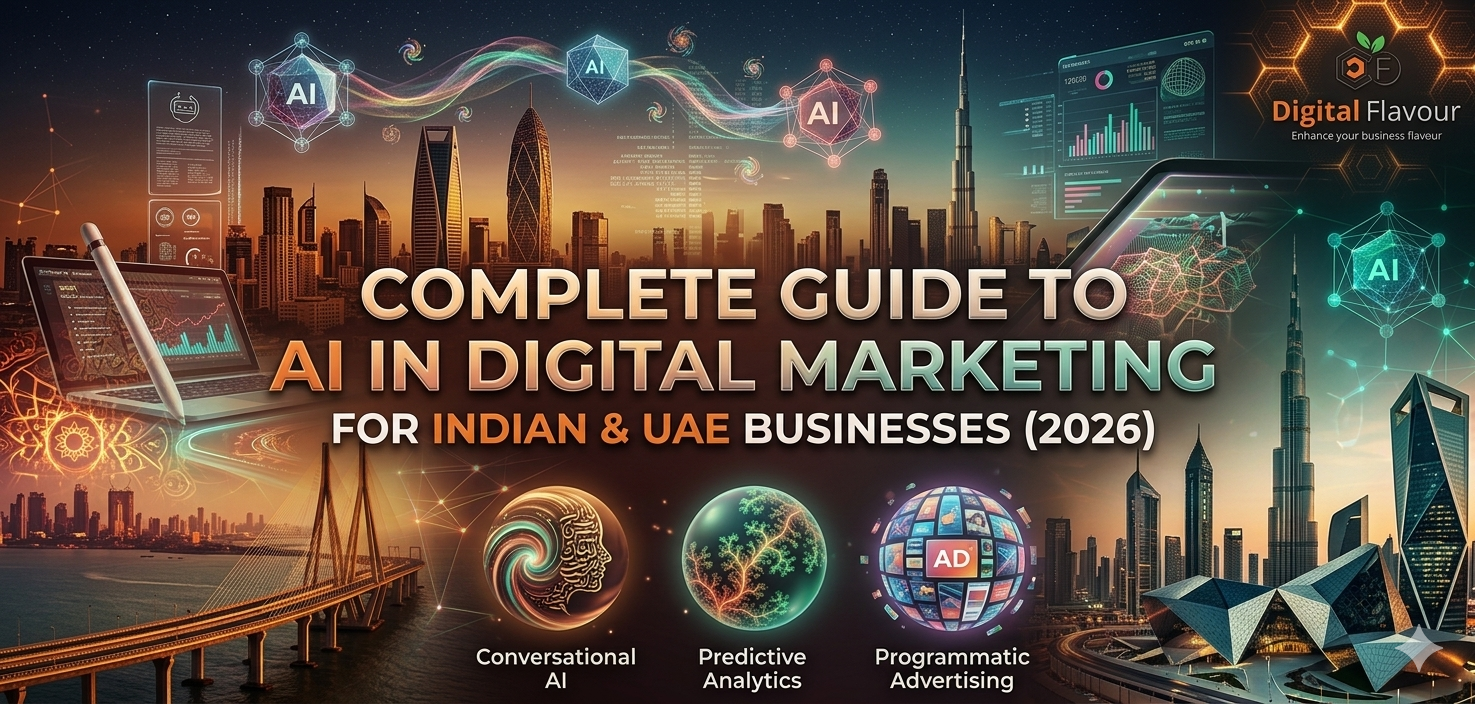
AI digital marketing refers to the use of artificial intelligence technologies, including machine learning, natural language processing, and predictive analytics, to plan, execute, and optimize digital marketing campaigns. In 2026, AI is used across SEO, paid advertising, social media, content creation, and customer personalization. Businesses in India and UAE are adopting AI marketing at record rates, with India leading global AI adoption at 30% and UAE digital ad spend projected to reach $2.64 billion by 2026.
There is a moment every business owner remembers, the one where a competitor’s ad followed them across three different platforms, spoke directly to something they were thinking about, and converted before the end of the day. You wondered how they did it. The answer, almost certainly, was AI.
Artificial intelligence is no longer a Silicon Valley luxury. It is the engine quietly running behind the most effective digital marketing campaigns you see today, in Mumbai, Bangalore, Indore, Dubai, and Abu Dhabi. It is deciding which ad to show to whom, writing email subject lines that actually get opened, figuring out which blog post to rank, and predicting what a customer wants to buy before they have typed it.
This guide is written specifically for business owners and marketing teams in India and the UAE who want to understand what AI digital marketing actually means, where it is already working, and how to start using it without wasting money or falling for the hype.
We have kept this practical. No theory for theory’s sake. Just what matters, what works, and what to do next.
What Is AI Digital Marketing? (A Plain-Language Answer)
AI digital marketing is the use of artificial intelligence, machine learning, natural language processing, computer vision, and predictive analytics, to make marketing decisions smarter, faster, and more personalized at scale.
Traditional marketing relied on a marketer’s instinct, historical data, and manual execution. AI marketing uses machines to process millions of data points simultaneously, past purchases, browsing behaviour, time spent on a page, email open history, search patterns, social media engagement, and acts on those signals in real time.
The result is that your marketing stops being generic and starts being relevant.
Think about what this looks like in practice:
- A real estate developer in Dubai uses AI to identify which website visitors are most likely to schedule a site visit — and serves them a WhatsApp message at exactly the right moment.
- A D2C clothing brand in Indore uses AI to generate 50 variations of an Instagram ad and automatically shows the best-performing version to each audience segment.
- A B2B SaaS company in Bangalore uses AI to write personalised email sequences for 10,000 prospects, each one feeling like it was written by hand.
This is not the future. This is happening right now, and businesses using it are pulling ahead of those that are not.
Why AI Digital Marketing Matters More in India and UAE Than Anywhere Else
Every market has its own dynamics, and both India and UAE have characteristics that make AI-powered marketing exceptionally valuable.
India: Scale, Diversity, and the AI Adoption Surge
India has over 900 million internet users. That number alone tells you the problem: reaching the right person among nearly a billion potential touchpoints is impossible without intelligent automation.
Add to that the linguistic complexity, Hindi, Tamil, Telugu, Kannada, Bengali, Marathi, and the regional buying behaviours that differ dramatically from state to state, and you start to understand why AI is not just useful in India, it is necessary.
The data confirms this shift is already underway. India leads global AI adoption at 30%, outpacing the world average of 26%. The Indian AI market has grown from $3.2 billion in 2020 to $6.05 billion in 2024, and analysts project it will reach $31.94 billion by 2031. India’s digital advertising market, valued at $6.71 billion in 2025, is projected to grow at a compound annual growth rate of 30.2% through 2035.
Among Indian businesses, 64% of SMEs report that AI enables them to compete on equal terms with larger competitors. That is not a small thing. For a mid-sized business in Indore or Pune, AI is the great equaliser.
UAE: Precision, Premium Audiences, and a 24/7 Economy
The UAE presents a different kind of opportunity. With 99% of the population being active internet users and 12.5 million social media accounts in a country of roughly 10 million people, meaning many residents maintain multiple active accounts, digital penetration is essentially total.
UAE digital ad spend is forecast to reach $2.64 billion by 2026. AI marketing revenue in the UAE alone is expected to grow from $394 million in 2023 to $2.1 billion by 2030. More than 70% of marketing budgets in the UAE are already dedicated to digital channels.
But here is what makes the UAE especially interesting for AI marketing: the audience is internationally diverse, extremely online, and — particularly in sectors like real estate, luxury retail, healthcare, and finance — operates with high purchase intent and significant lifetime value per customer. Getting targeting right in Dubai is not just nice to have. A single converted lead in luxury real estate can justify months of marketing spend. AI makes that precision possible.
How Is AI Used in Digital Marketing? The Six Key Areas
1. AI-Powered SEO: Ranking Smarter, Not Just Working Harder
Search engine optimization has always been about understanding what people are looking for and creating content that answers it better than anyone else. AI has changed both sides of that equation, how people search and how marketers respond.
Google’s AI Overviews now appear in nearly 19% of search results globally. ChatGPT handled an estimated 17% of digital queries by the end of 2025. Perplexity, Claude, Gemini, all of them are answering questions that would previously have sent someone to a search results page. This means that for a business to remain discoverable, it needs to be the source these AI systems draw from.
In practical terms, AI SEO now means:
Topical authority over keyword stuffing. Search engines, and AI language models, reward content that comprehensively covers a subject. One thorough, well-structured guide outperforms ten shallow posts targeting the same keyword.
Conversational content structure. People ask AI systems questions the way they would ask a colleague. Content structured around direct, clear answers to specific questions, the questions your customers actually ask, is what gets cited in AI-generated responses.
Technical SEO at speed. AI tools now audit websites in minutes, identifying page speed issues, broken links, missing schema markup, and crawl errors that would take days to find manually.
Predictive keyword research. Rather than chasing keywords after they trend, AI tools identify topics gaining momentum before they peak, giving early movers a significant ranking advantage.
For businesses in India targeting regional audiences, AI-powered SEO also means optimising for voice search in local languages. Multilingual voice search queries are growing rapidly, and businesses that prepare for conversational Hindi, Tamil, or Arabic search queries now will have a meaningful head start.
At Digital Flavour, our Local SEO services are built around this new reality, combining technical SEO foundations with content strategies designed to perform in both traditional search and AI-driven discovery.
2. AI in Paid Advertising: Spending Less, Converting More
If there is one area where AI has delivered the most immediate, measurable ROI in digital marketing, it is paid advertising. The numbers are hard to argue with: AI-driven campaigns consistently deliver 22% higher ROI than traditionally managed campaigns.
Google’s Performance Max campaigns use AI to allocate budget across Search, Display, YouTube, Gmail, and Maps simultaneously, optimising in real time based on conversion signals. A campaign that would have taken a skilled analyst days to set up and weeks to optimise now adjusts itself every hour.
Meta’s Advantage+ campaigns use machine learning to find audiences most likely to convert, automatically test creative variations, and shift spend toward what is working. For e-commerce brands in India, this has been particularly powerful, AI can identify which product, message, and format works for a customer in Tier 2 cities versus metropolitan audiences.
Smart bidding strategies — Target CPA, Target ROAS, Maximise Conversions, use AI to adjust bids at the moment of each auction based on dozens of signals: device, time of day, location, search history, and more.
For UAE businesses, where ad costs in sectors like real estate and finance can be significant, this precision is not optional. A single misallocated budget in a high-competition market can cost more than a month’s optimisation work. AI makes every dirham count.
Our Google Ads management and Meta Ads services at Digital Flavour are built around these AI-powered campaign structures, human strategy combined with machine-level optimisation.
3. AI for Content Creation: Scale Without Losing Your Voice
Let’s be clear about something important, because a lot of agencies will not tell you this: AI-generated content published without human review, editing, and strategic oversight does not work. A survey of over 500 Indian businesses found that those who published AI content directly, without human oversight, saw no meaningful ROI from it.
What does work is using AI as a force multiplier for skilled human marketers.
Here is what that looks like in practice:
Ideation and research — AI can analyse thousands of competitor articles, customer reviews, and search queries in minutes to identify content gaps and angle opportunities that would take a human researcher days to find.
First-draft acceleration — A skilled content writer who would previously produce two or three articles a week can now produce eight or ten, with AI handling the initial structure and research compilation while the writer focuses on insight, voice, and quality.
Personalisation at scale — AI can generate hundreds of email subject line variants, social media caption options, and ad copy alternatives for A/B testing, work that would be economically impossible to commission manually.
Visual content production — AI video tools have reduced ad production timelines from weeks to hours. A travel agency can now generate 50 location-specific ad creatives with appropriate messaging for each destination automatically. For UAE businesses targeting multilingual audiences, AI can adapt creative assets for English, Arabic, Hindi, and Urdu audiences from a single brief.
The key insight is this: in 2026, every one of your competitors has access to the same AI content tools. The differentiation comes from the human thinking, strategic positioning, and genuine expertise that guides how those tools are used.
4. AI-Powered Social Media Marketing: Smarter Scheduling, Sharper Targeting
Social media marketing has always been part art, part science. AI has significantly expanded the science side, making it possible to understand audience behaviour, predict content performance, and automate distribution at a level that was previously only available to enterprise-scale teams.
Predictive content scheduling — AI analyses engagement data from your specific audience to identify the optimal posting times for each platform and audience segment, rather than relying on generic best-practice guides.
Sentiment analysis and social listening — AI tools monitor conversations about your brand, your competitors, and your industry across social platforms, surfacing customer pain points, emerging topics, and PR risks in real time.
Dynamic creative optimisation — AI continuously tests creative variants, identifying which combinations of visuals, copy, and calls-to-action resonate with specific audience segments, then automatically shifts distribution toward what is working.
Chatbot automation — AI-powered chatbots on Instagram, Facebook, and WhatsApp handle initial customer enquiries around the clock. For UAE businesses operating across time zones, this is particularly valuable, a prospect messaging at 11pm receives an intelligent, personalised response immediately rather than waiting until business hours.
India is a WhatsApp-first nation. The customer journey increasingly begins, and often ends, on messaging platforms. AI-powered conversational marketing on WhatsApp is one of the highest-leverage tools available to Indian businesses right now, combining the intimacy of personal messaging with the scale of automation.
Explore our Social Media Marketing services to see how we integrate AI-driven strategies for both Indian and UAE audiences.
5. AI for Email Marketing: Personalisation Beyond the First Name
Email marketing delivers $36 for every $1 spent, the highest ROI of any digital channel. AI has made that ratio even more favourable by enabling a level of personalisation that first-name tokens only scratch the surface of.
Behavioural triggers — AI can send the right email at the right moment based on specific customer actions: a product page visit, a cart abandonment, a download, a service page view. Each trigger can fire a personalised sequence tailored to what the customer was looking at.
Predictive send-time optimisation — Rather than blasting your entire list at 9am Tuesday because that is when most brands send emails, AI identifies the specific time each individual subscriber is most likely to open and engage.
Dynamic content blocks — A single email template can serve completely different product recommendations, case studies, or offers to different segments — all determined by AI analysis of past behaviour and current context.
Subject line optimisation — AI tests hundreds of subject line variants across small audience segments and promotes the highest-performing version to the broader list — a process that would be prohibitively time-consuming manually.
For B2B businesses in both India and UAE, AI-powered email sequences that adapt based on how prospects engage — clicking certain links, visiting certain pages, opening at certain times — can dramatically shorten sales cycles.
6. AI Analytics and Predictive Insights: Stop Guessing
Marketing without data is expensive guesswork. Marketing with data but without AI is expensive slowness. AI changes the relationship between data and decision-making by compressing the time between insight and action.
Predictive analytics — AI models analyse historical campaign data, seasonality patterns, market trends, and competitive signals to forecast which campaigns, products, or audience segments are likely to perform best in the coming period, allowing proactive rather than reactive budget allocation.
Attribution modelling — Modern customer journeys span eight to twelve touchpoints across multiple platforms before conversion. AI-powered attribution models give marketing teams a much more accurate picture of which channels are actually driving revenue, a critical input for budget decisions.
Customer lifetime value prediction — AI can identify which new customers are most likely to become high-value, long-term clients based on early behavioural signals, allowing businesses to invest more acquisition cost in acquiring the right customers.
Churn prediction — For subscription businesses, AI can identify customers showing early disengagement signals weeks before they would otherwise cancel, creating an intervention window that traditional analytics would miss entirely.
Will AI Replace Digital Marketers? The Honest Answer
This question comes up in almost every conversation about AI in marketing, and it deserves a direct answer.
AI will not replace skilled digital marketers. It is already replacing unskilled, process-driven marketing work — and that distinction matters.
The evidence is nuanced. 23% of agencies reduced junior copywriting headcount in 2025, and 31% plan further cuts in 2026. At the same time, demand for senior content strategists is growing at 18% year-over-year. The marketing org chart is not shrinking — it is reshaping.
What AI cannot do: understand the cultural nuance of an Indian festival season campaign and why the same message lands differently in Punjab and Kerala. Know that a Dubai real estate client’s audience responds better to aspiration than features. Build a genuinely original strategic perspective on a competitive market. Earn the trust of a client through a difficult campaign period. Make the creative judgment call that turns a good campaign into an unforgettable one.
What AI can do: handle the volume, speed, repetition, and data processing that used to consume most of a marketer’s working hours — freeing them to do the work that actually requires human judgment.
The marketers and agencies thriving in 2026 are those who treat AI as infrastructure — not as a replacement for thinking, but as the platform on which good thinking can operate at scale. Businesses that went all-in on fully automated AI content without human oversight found this out the hard way. Those that combined AI efficiency with human strategy are seeing 3× to 4× better results than their manual-only competitors.
AI Digital Marketing in Practice: India vs UAE — Key Differences
While the tools are the same, the strategies need to reflect the markets.
India
Language diversity is the challenge and the opportunity. AI tools that can generate, adapt, and optimise content across regional languages give businesses a genuine competitive advantage. Voice search in Hindi, Tamil, and other regional languages is growing rapidly — optimise for it now.
Mobile-first is non-negotiable. Over 85% of India’s internet users access the web primarily on mobile. Every AI-driven marketing strategy needs to be designed for mobile experience first — from page speed to ad format to conversion flow.
WhatsApp as a primary channel. India’s WhatsApp penetration makes it one of the most powerful — and underused — marketing channels available. AI-powered conversational marketing on WhatsApp, with automated yet personalised follow-up sequences, is delivering exceptional results for businesses across e-commerce, real estate, education, and healthcare.
Tier 2 and Tier 3 city opportunities. AI tools make it economically viable to build marketing strategies specifically for Tier 2 cities like Indore, Jaipur, Lucknow, and Coimbatore — audiences that larger national brands often under-serve. For regional agencies and businesses, this is significant whitespace.
UAE
Multi-nationality, multi-language audiences. The UAE population includes significant communities from India, Pakistan, the Philippines, Egypt, the UK, and dozens of other countries. AI tools that can personalise content and ads based on language and cultural background — rather than treating the UAE as a monolithic audience — deliver materially better results.
Arabic-first SEO. Despite English being widely spoken in business contexts, Arabic-language search is growing rapidly and remains significantly less competitive than English-language SEO in the UAE. Businesses that build Arabic content strategies now are capturing high-quality traffic at lower cost.
Premium audience expectations. UAE consumers, particularly in Dubai, expect a level of polish and personalisation that generic marketing cannot deliver. AI-powered personalisation — dynamic website content, tailored ad creative, intelligent email sequences — aligns with the expectations of this market.
Regulatory awareness. The UAE has specific advertising standards and content regulations that AI content tools do not automatically account for. Human review remains essential to ensure compliance.
How to Start With AI Digital Marketing: A Practical Roadmap
The question most business owners ask after understanding the opportunity is: where do we actually start?
Here is a sensible sequence that works whether you are a business owner in Indore or a marketing manager in Dubai.
Step 1: Audit your current marketing baseline. Before introducing AI, understand what your current campaigns are actually doing — which channels are generating leads, which content is driving traffic, where your conversion rates stand. AI will amplify what exists, not fix what is broken.
Step 2: Start with one high-leverage AI application. The most common mistake is trying to implement AI everywhere at once. Choose the area where the potential ROI is clearest for your specific business — often paid advertising AI tools or email marketing automation — and do it properly before expanding.
Step 3: Combine AI tools with human strategic oversight. Establish a workflow where AI generates and optimises, and skilled humans review, refine, and direct. Businesses that skip the human layer are the ones publishing generic content and wondering why it is not working.
Step 4: Measure rigorously and iterate. AI marketing generates enormous amounts of data. The businesses that pull ahead are those that actually use it — reviewing performance weekly, updating targeting and creative based on AI insights, and constantly testing new approaches.
Step 5: Partner with an AI-native agency. For most businesses, the fastest path to AI marketing ROI is working with an agency that already has the tools, expertise, and process — rather than building internal capability from scratch while managing your core business.
At Digital Flavour, we work with businesses across India and UAE to build AI-powered digital marketing systems that generate measurable results. From SEO and content marketing to Google Ads, Meta Ads, and social media management — our strategies are built for the specific dynamics of both markets.
Frequently Asked Questions About AI Digital Marketing
How is AI used in digital marketing?
AI is used across every major area of digital marketing. In SEO, AI tools perform technical audits, keyword research, and content optimisation at speed. In paid advertising, AI manages bidding, targeting, and creative testing automatically. In content marketing, AI assists with research, drafting, and personalisation. In email marketing, AI enables behavioural triggers, send-time optimisation, and dynamic content. In social media, AI handles scheduling optimisation, sentiment monitoring, and chatbot automation. In analytics, AI generates predictive insights and attribution models that manual analysis cannot match.
What are the benefits of AI in digital marketing?
The core benefits are speed, scale, and precision. AI allows businesses to execute marketing at a scale that would require enormous human teams to replicate manually — running hundreds of ad variants simultaneously, sending personalised emails to thousands of subscribers, monitoring brand mentions across dozens of platforms in real time. The precision benefit comes from AI’s ability to process vast amounts of behavioural data to make targeting and personalisation decisions that generic marketing cannot match. The result, across well-managed campaigns, is higher ROI, lower cost per acquisition, and better customer experience.
What is the role of AI in SEO?
AI has changed SEO in two directions simultaneously — how search engines evaluate content, and how marketers produce and optimise it. Search engines, including Google, now use AI to understand search intent and content quality more sophisticatedly than keyword matching alone. For marketers, AI tools help with technical SEO audits, content gap analysis, competitive research, schema markup implementation, and identifying emerging keyword opportunities before they become competitive. AI also helps with GEO — Generative Engine Optimisation — which is the practice of structuring content so it is cited and surfaced by AI search tools like ChatGPT, Gemini, and Perplexity, not just ranked in traditional search results.
How does AI improve Google Ads performance?
Google Ads AI tools — Performance Max, Smart Bidding, responsive search ads — use machine learning to optimise campaigns in real time based on conversion signals that human managers cannot process at the same speed or scale. Smart Bidding adjusts the bid for every single auction based on dozens of contextual signals including device, location, time, and search history. Performance Max allocates budget across Google’s entire advertising inventory automatically, shifting spend toward the channels and formats that are converting. For well-structured campaigns with clean conversion tracking, AI bidding consistently outperforms manual management within two to four weeks of sufficient data accumulation.
Which AI tools are best for digital marketing in 2026?
The most widely used and well-validated AI marketing tools in 2026 include: ChatGPT (OpenAI) for content ideation, copywriting assistance, and customer communication; Gemini (Google) for content creation integrated with Google Workspace; Jasper for marketing-specific AI writing; Surfer SEO for AI-powered content optimisation and SEO scoring; Semrush AI tools for competitive research and keyword analysis; Meta Advantage+ for AI-driven social advertising; Google Performance Max for cross-channel advertising automation; HubSpot AI for CRM-integrated marketing automation; and Elevenlabs for AI voiceover production. The right tool set depends on your specific channels, team capabilities, and budget.
Will AI replace digital marketers?
The honest answer is: AI is replacing certain types of marketing work, not marketing professionals. Repetitive, process-driven tasks — bulk content production without strategic direction, manual bid adjustments, basic reporting — are being automated. What is growing is demand for marketers who can direct AI tools strategically, interpret AI-generated insights, apply cultural and market context that AI lacks, and make the creative and strategic judgements that machines cannot. Agencies and marketers who treat AI as a platform for their expertise rather than a threat to it are growing. Those who resist the shift or rely on it entirely without adding human value are struggling.
How is AI changing digital marketing in India specifically?
India’s combination of massive scale, regional language diversity, and mobile-first internet usage makes AI especially valuable. AI enables personalisation at a scale that India’s market requires — reaching the right person in the right language on the right platform at the right moment. Key AI applications gaining traction in India include: multilingual content generation and translation, WhatsApp automation for lead nurturing and customer service, predictive analytics for e-commerce inventory and seasonal campaign planning, AI-powered regional language SEO and voice search optimisation, and performance marketing automation for Tier 2 and Tier 3 city audiences.
How is AI changing digital marketing in the UAE and Dubai?
The UAE market’s unique characteristics — a highly connected, multi-national, premium-expectation audience — make AI’s personalisation and targeting capabilities particularly valuable. AI is being used extensively in UAE digital marketing for: Arabic-language content generation and SEO, multi-language ad creative personalisation, AI chatbots for real estate, hospitality, and retail sectors, predictive analytics for high-value customer acquisition, programmatic advertising optimisation, and Generative Engine Optimisation to ensure visibility in AI-driven search tools used heavily by the UAE’s tech-forward population.
The Bottom Line: AI Digital Marketing Is Not Optional Anymore
Here is where things stand in 2026: 88% of marketers worldwide use AI daily. 87% use generative AI in at least one recurring marketing workflow. AI content drafting delivers 3.2× ROI on average, according to McKinsey. Globally, AI marketing tools now have 2.42 billion monthly active users — nearly doubling in a single year.
In India, the businesses pulling ahead are using AI to compete at scale with far fewer resources than their larger rivals. In the UAE, the brands winning are using AI to deliver the precision and personalisation that premium markets demand.
The question for your business is not whether to adopt AI in your digital marketing. That decision has already been made by the market around you. The question is how to implement it strategically — combining the efficiency of machine intelligence with the judgment, creativity, and market understanding that only experienced people can provide.
If you are a business in India or the UAE looking to understand what an AI-powered digital marketing strategy would look like for your specific situation, Digital Flavour’s team works with companies across both markets to build and execute these strategies — with a clear focus on measurable business outcomes, not just marketing activity.