Blog

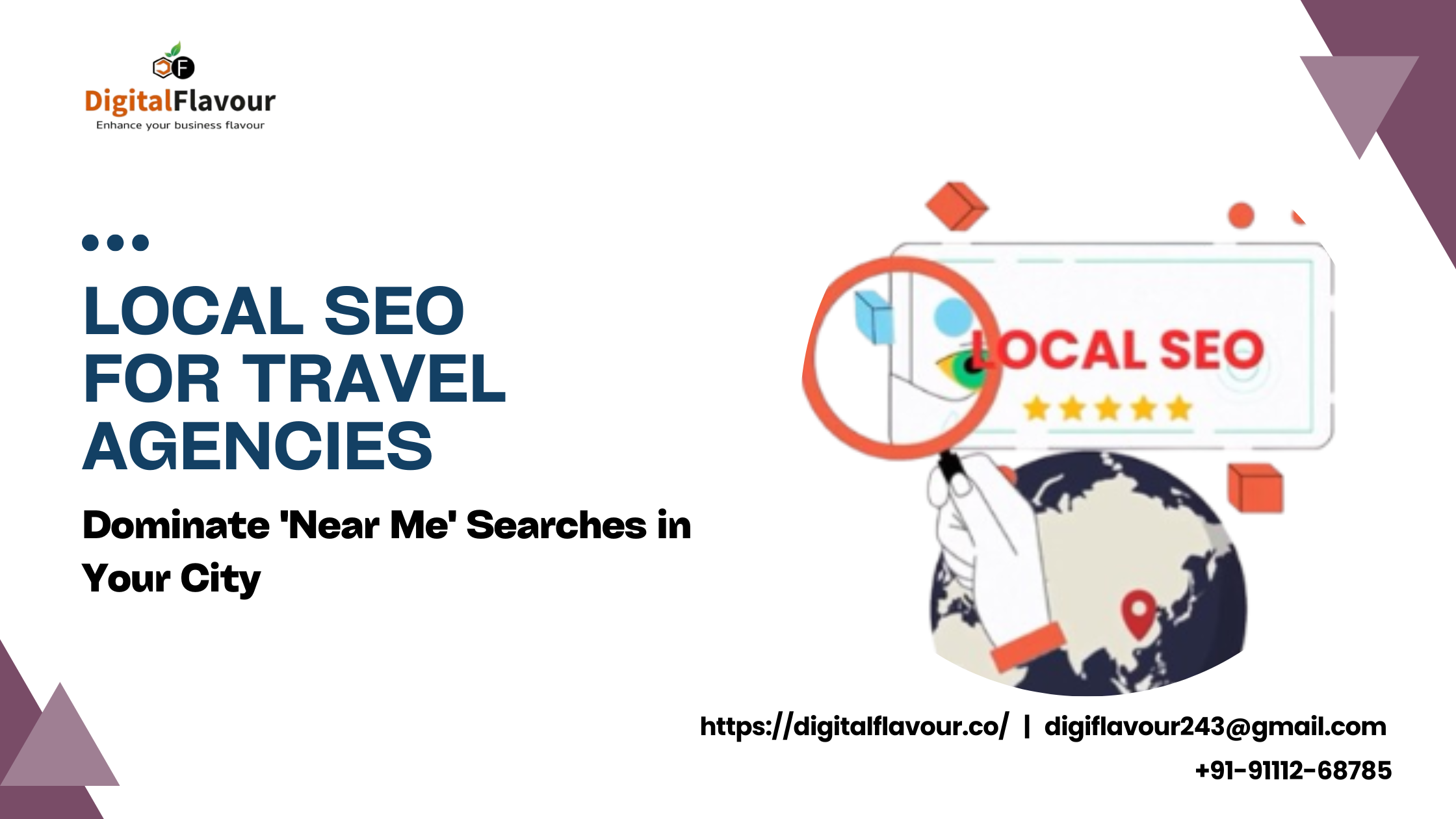
  • Local SEO for Travel Agencies: Dominate ‘Near Me’ Searches in Your City

    Local SEO for Travel Agencies: Dominate ‘Near Me’ Searches in Your City

    Last Updated: September 2025 | Reading Time: 16 minutes

    In today’s hyperconnected world, travelers still crave the personal touch that only local travel agencies can provide. Despite the dominance of online booking platforms, 68% of travelers prefer working with local travel agents for complex trips, and “travel agent near me” searches have increased by 156% since 2023.

    If your travel agency isn’t appearing in local search results, you’re missing out on a goldmine of ready-to-book customers actively searching for your services. This comprehensive guide by Digital Flavour, leading Digital Marketing Agency for Travel Agency will show you exactly how to dominate local search results and capture more “near me” searches than your competitors.

    Why Local SEO is Critical for Travel Agencies {#why-local-seo-critical}

    The Local Advantage in Travel

    While online travel agencies (OTAs) dominate broad keyword searches, local travel agencies have a significant advantage in location-based searches. Here’s why local SEO should be your primary focus:

    Trust Factor: 92% of travelers trust recommendations from local businesses more than online reviews from strangers. When someone searches for “travel agent near me,” they’re looking for personalized service and local expertise.

    Lower Competition: While competing with Expedia and Booking.com for “vacation packages” is nearly impossible, ranking #1 for “travel agent in [your city]” is entirely achievable with the right strategy.

    Higher Conversion Rates: Local searches convert 5x higher than general searches because the intent is clearer—these prospects are ready to meet and book.

    The Numbers Don’t Lie

    Recent industry data reveals the power of local SEO for travel agencies:

    • 73% of local searches result in a phone call or visit within 24 hours
    • “Near me” searches have grown 900% over the past two years
    • 46% of Google searches have local intent
    • Local businesses with complete Google Business Profiles are 70% more likely to attract location visits
    • 78% of mobile local searches result in offline purchases

    Understanding Local Search Behavior {#local-search-behavior}

    How Travelers Search Locally

    Understanding search patterns helps you optimize for actual user behavior:

    Primary Search Patterns:

    1. “Travel agent near me” – 12,100 monthly searches
    2. “Travel agency in [city]” – 8,900 monthly searches
    3. “Best travel agent [city]” – 6,400 monthly searches
    4. “Local travel agency” – 4,200 monthly searches
    5. “Travel agent [zip code]” – 2,800 monthly searches

    Search Intent Analysis:

    Immediate Need Searches (High Commercial Intent):

    • “Travel agent open now”
    • “Emergency travel booking near me”
    • “Same day travel agent”
    • “Walk-in travel agency”

    Research Phase Searches (Medium Commercial Intent):

    • “Best travel agencies in [city]”
    • “Travel agent reviews [city]”
    • “Local vs online travel booking”
    • “Travel agent consultation near me”

    Service-Specific Searches (High Commercial Intent):

    • “Honeymoon planner [city]”
    • “Corporate travel agent near me”
    • “Group travel organizer [city]”
    • “Luxury travel consultant [city]”

    Mobile vs Desktop Local Search

    Mobile devices account for 78% of local travel searches, with distinct behavior patterns:

    Mobile Search Characteristics:

    • Voice searches: 27% of mobile local searches are voice-activated
    • Immediate action: 76% visit a location within 24 hours
    • Call directly: 61% call the business immediately
    • Quick decisions: Average of 2.3 businesses considered before choosing

    Desktop Search Characteristics:

    • Research-focused: Users compare 4.7 businesses on average
    • Detailed information: Spend 3.2x longer on business websites
    • Multiple sessions: 68% return to research before booking
    • Form submissions: 43% prefer contact forms over phone calls

    Google Business Profile Mastery {#google-business-profile}

    Your Google Business Profile (GBP) is the foundation of local SEO success. It’s often the first impression potential customers have of your travel agency.

    Complete Profile Optimization

    Business Information Essentials

    Business Name: Use your exact legal business name. Avoid keyword stuffing like “ABC Travel Agency – Best Tours in Chicago.” This can result in suspension.

    Correct: “Wanderlust Travel Agency” ❌ Incorrect: “Wanderlust Travel Agency – Best Deals & Tours Chicago”

    Primary Category: Select “Travel agency” as your primary category. This is crucial for appearing in relevant searches.

    Additional Categories (Choose up to 9 more):

    • Tour operator
    • Cruise agency
    • Corporate travel agency
    • Travel insurance agency
    • Visa consultant
    • Travel insurance consultant
    • Event planner (if you organize travel events)
    • Wedding planner (if you specialize in destination weddings)

    Business Description (750 characters maximum): Craft a compelling description that includes:

    • Your unique value proposition
    • Key services offered
    • Years of experience
    • Service areas
    • Specializations

    Example Description: “Established in 2010, Wanderlust Travel Agency specializes in custom vacation packages, luxury tours, and corporate travel management. Our certified travel advisors have planned over 5,000 trips to 80+ countries. We offer personalized service, competitive pricing, and 24/7 travel support. Serving Chicago and surrounding areas with expertise in European tours, tropical getaways, adventure travel, and destination weddings. Free consultation available.”

    Service Areas and Location Strategy

    Physical Location Strategy:

    • Include your complete address with suite/unit numbers
    • Ensure your location is accurate to within 10 meters
    • Use a consistent address format across all platforms
    • If you work from home, consider a virtual office or coworking space

    Service Area Optimization: Define your service areas strategically. Instead of selecting entire states, choose specific cities and regions where you actively market:

    Strategic Service Area Selection:

    • Primary city (where your office is located)
    • Surrounding suburbs (within 50-mile radius)
    • Secondary markets where you have clients
    • Tourist destinations you specialize in

    Visual Content Strategy

    Photo Optimization for Travel Agencies

    Your visual content directly impacts click-through rates and bookings. With over 3.5 billion searches conducted daily on Google, having a Google Business Profile ensures that your travel agency appears in relevant search results.

    Essential Photo Categories:

    1. Exterior Photos (3-5 photos)

    • Street view of your office
    • Building entrance with signage
    • Parking information
    • Accessibility features

    2. Interior Photos (5-8 photos)

    • Reception area
    • Consultation rooms
    • Team working spaces
    • Awards and certifications displayed

    3. Team Photos (3-5 photos)

    • Professional headshots of travel advisors
    • Team meeting photos
    • Staff helping clients
    • Travel certification displays

    4. Destination Showcase (10-15 photos)

    • High-quality images of popular destinations
    • Client travel photos (with permission)
    • Tour groups you’ve organized
    • Special events and experiences

    5. Behind-the-Scenes (3-5 photos)

    • Planning sessions
    • Map and itinerary creation
    • Client testimonial moments
    • Office culture and events

    Photo Optimization Tips:

    • Resolution: Upload high-resolution images (minimum 720px wide)
    • File names: Use descriptive names like “chicago-travel-agency-office.jpg”
    • Geotagging: Include location data in photo metadata
    • Regular updates: Add new photos monthly to show activity
    • Seasonal content: Update with seasonal destination photos

    Google Posts Strategy

    Google Posts appear directly in your business profile and can significantly boost engagement and local rankings.

    Content Calendar for Google Posts

    Weekly Post Schedule:

    Monday – Destination Spotlight

    • Featured destination of the week
    • Travel tips and insights
    • Best time to visit information
    • Include booking CTA

    Wednesday – Travel Tips

    • Packing advice
    • Travel safety tips
    • Cultural insights
    • Seasonal travel recommendations

    Friday – Client Success Stories

    • Anonymous client testimonials
    • Trip highlights
    • Photo galleries from client trips
    • Social proof elements

    Special Posts:

    • Holiday Travel Alerts: During peak seasons
    • Last-Minute Deals: For immediate bookings
    • Travel Warnings: Safety and health updates
    • New Service Announcements: Business updates

    Post Optimization Best Practices

    Content Structure:

    • Hook: Start with an attention-grabbing first line
    • Value: Provide useful information or insights
    • CTA: Clear call-to-action for engagement
    • Keywords: Include location-based keywords naturally

    Example Google Post: “🌺 Planning a Hawaiian getaway? Our Maui packages include oceanview accommodations, snorkeling tours, and traditional luau experiences. Perfect for Chicago residents escaping winter! Book your consultation today and save $200 on bookings made this month. #HawaiiTravel #ChicagoTravel”

    Q&A Optimization

    Proactively manage your Q&A section to control the narrative and provide valuable information.

    Essential Questions to Add:

    1. “What travel destinations do you specialize in?” Answer: “We specialize in European tours, Caribbean getaways, African safaris, and Asian adventures. Our team has personal experience in over 80 countries and can create custom itineraries for any destination.”
    2. “Do you offer payment plans for vacation packages?” Answer: “Yes! We offer flexible payment plans with as little as $200 down and up to 12 months to pay. We also accept all major credit cards and offer travel insurance options.”
    3. “What’s included in your travel planning services?” Answer: “Our full-service planning includes flights, accommodations, transportation, tours, restaurant reservations, and 24/7 travel support. We handle all details so you can focus on enjoying your trip.”
    4. “How far in advance should I book my vacation?” Answer: “We recommend 3-6 months for international travel and 6-8 weeks for domestic trips. However, we can arrange last-minute travel within 48 hours for urgent needs.”
    5. “Do you charge consultation fees?” Answer: “Your first consultation is always free! We’ll discuss your travel dreams, provide destination recommendations, and create a preliminary itinerary at no cost.”

    Local Keyword Strategy {#local-keyword-strategy}

    Geographic Keyword Research

    Local SEO for travel agencies requires a different approach to keyword research. You’re not just competing for travel terms—you’re dominating location-based searches.

    Primary Local Keywords

    High-Volume Local Keywords:

    • “travel agent [city]” – Primary focus keyword
    • “travel agency [city]” – Secondary focus
    • “[city] travel services” – Service-based variation
    • “vacation packages [city]” – Product-focused
    • “tour operator [city]” – Service specialty

    Long-Tail Local Keywords (Higher Conversion Rate):

    • “best travel agent in [city] for [destination]”
    • “[city] travel agency for honeymoons”
    • “corporate travel services [city]”
    • “family vacation planner [city]”
    • “luxury travel consultant [city]”

    Service Area Expansion Keywords

    If you serve multiple cities or regions:

    Multi-Location Strategy:

    • Create dedicated pages for each service area
    • Use “serving [city1], [city2], and [city3]” in content
    • Include “near [landmark]” variations
    • Target neighborhood-specific terms

    Example Multi-Location Content: “Serving Chicago, Naperville, Schaumburg, and Northwest Suburbs” “Located in downtown Chicago, convenient to O’Hare and Midway airports” “Travel planning services throughout Chicagoland area”

    Competitor Keyword Analysis

    Understanding what keywords your local competitors rank for helps identify opportunities.

    Local Competitor Research Process:

    Step 1: Identify top 5 local travel agency competitors Step 2: Analyze their Google Business Profiles for keyword usage Step 3: Review their website content and meta descriptions Step 4: Use SEO tools to uncover their ranking keywords Step 5: Identify keyword gaps where you can compete

    Common Competitor Keyword Gaps:

    • Specialized travel types (adventure, wellness, eco-tourism)
    • Specific destinations they don’t promote
    • Service offerings they don’t highlight
    • Demographic-specific terms (senior travel, family travel)

    Content Mapping for Local Keywords

    Create a strategic content plan that targets different local keyword variations:

    Page-Level Keyword Targeting:

    Homepage:

    • Primary: “travel agency [city]”
    • Secondary: “vacation packages [city]”, “[city] travel services”

    Services Pages:

    • “/honeymoon-packages/” → “honeymoon travel agent [city]”
    • “/corporate-travel/” → “business travel services [city]”
    • “/group-travel/” → “group vacation planner [city]”

    Destination Pages:

    • “/europe-tours/” → “[city] to Europe travel packages”
    • “/caribbean-vacations/” → “Caribbean vacation packages from [city]”

    Location Pages (if serving multiple areas):

    • “/naperville-travel-agency/” → “travel agent Naperville IL”
    • “/schaumburg-travel-services/” → “Schaumburg travel agency”

    Citation Building and NAP Consistency {#citation-building}

    Citation building is the process of getting your business name, address, and phone number (NAP) listed consistently across the web. For travel agencies, this is crucial for local search visibility.

    NAP Consistency Rules

    NAP Format Standardization: Your business information must be identical across all platforms. Even minor variations can hurt your local rankings.

    Correct NAP Example:

    • Name: Wanderlust Travel Agency
    • Address: 123 Main Street, Suite 456, Chicago, IL 60601
    • Phone: (312) 555-0123

    Common NAP Mistakes to Avoid: ❌ Using different business name variations ❌ Abbreviating street names inconsistently (St. vs Street) ❌ Including suite numbers on some listings but not others ❌ Using different phone number formats ❌ Mixing P.O. Boxes with physical addresses

    High-Authority Citation Sources

    Travel Industry Directories

    Tier 1 Citations (Highest Priority):

    • TripAdvisor Business Listings – Essential for travel credibility
    • Yelp for Business – Major review platform with high domain authority
    • Better Business Bureau – Trust and credibility signal
    • Google Business Profile – Already covered but most important
    • Bing Places – Microsoft’s local platform

    Tier 2 Citations (High Priority):

    • Yellow Pages – Traditional directory with strong local authority
    • Superpages – Comprehensive business directory
    • Whitepages – Local business listings
    • Citysearch – Local discovery platform
    • Hotfrog – Business directory with good SEO value

    Tier 3 Citations (Good to Have):

    • Foursquare – Location-based platform
    • Factual – Data aggregator that feeds other platforms
    • InfoUSA – Business data provider
    • Acxiom – Data management platform
    • Localeze – Business listing service

    Travel-Specific Directories

    Industry Authority Citations:

    • ASTA (American Society of Travel Advisors) – Professional association
    • IATAN (International Airlines Travel Agent Network) – Travel agent certification
    • Cruise Lines International Association (CLIA) – Cruise specialist directory
    • Local tourism boards – City/state tourism directories
    • Chamber of Commerce – Local business authority

    Citation Building Process

    Phase 1: Audit Existing Citations (Week 1)

    Citation Audit Checklist:

    1. Search “[Business Name] + [City]” in Google
    2. Check first 3 pages of results for existing citations
    3. Document NAP variations found
    4. Note incomplete or incorrect listings
    5. Identify duplicate listings that need merging

    Tools for Citation Auditing:

    • Free: Manual Google searches, Bing searches
    • Paid: BrightLocal Local Search Results Checker, Whitespark Citation Tracker

    Phase 2: Fix Existing Issues (Week 2-3)

    Priority Order:

    1. Claim and verify unclaimed listings
    2. Correct NAP inconsistencies on major platforms
    3. Complete incomplete profiles with full information
    4. Merge duplicate listings where possible
    5. Remove outdated listings for old locations/phones

    Phase 3: Build New Citations (Week 4-8)

    Strategic Citation Building:

    • Submit to 5-10 new directories per week
    • Focus on high-authority general directories first
    • Add travel-specific directories second
    • Include local/city-specific directories third
    • Monitor for approval and listing activation

    Local Link Building Through Citations

    Transform citations into valuable backlinks:

    Value-Added Citation Strategy:

    1. Complete all available fields in directory listings
    2. Add detailed business descriptions with keywords
    3. Include high-quality photos when possible
    4. Link to specific landing pages rather than just homepage
    5. Encourage reviews on citation platforms

    Review Management Strategy {#review-management}

    Online reviews are crucial for local search rankings and customer trust. For a travel agency operating in a certain city, region, or country, local SEO matters. It allows your agency to show up in the local search results, on Google Maps, and “search near me” inquiries.

    Review Platform Priority

    Primary Review Platforms (Focus 80% of effort):

    1. Google Business Profile

    • Impact: Directly affects local search rankings
    • Visibility: Reviews appear in search results and Maps
    • Response Time: Respond within 24 hours
    • Target: 4.5+ star average with 50+ reviews

    2. Facebook Business Page

    • Impact: Social signals affect SEO
    • Visibility: Reviews appear in Facebook search and timeline
    • Response Time: Respond within 2 hours during business hours
    • Target: 4.8+ star average with 25+ reviews

    3. TripAdvisor

    • Impact: Industry-specific authority
    • Visibility: High visibility for travel-related searches
    • Response Time: Respond within 48 hours
    • Target: 4.5+ star average with 30+ reviews

    Secondary Review Platforms (Focus 20% of effort):

    • Yelp: Important for urban areas
    • Better Business Bureau: Trust and credibility
    • Travel Weekly: Industry professional network
    • Local tourism websites: City-specific platforms

    Review Generation System

    Automated Review Request Process

    Client Journey Touchpoints:

    1. Post-Consultation Follow-Up (24 hours after meeting) Email template: “Thank you for visiting our office yesterday. We hope our travel recommendations were helpful. If you were satisfied with our consultation, we’d greatly appreciate a quick review on Google. It helps other Chicago travelers discover our services.”

    2. Pre-Departure Check-In (1 week before travel) “Your [destination] adventure begins in one week! We’re excited for you. If our planning process exceeded your expectations, please consider leaving a review to help other families plan their perfect getaways.”

    3. Post-Trip Follow-Up (1 week after return) “Welcome back from [destination]! We hope you had an amazing time. We’d love to hear about your experience and would appreciate a review sharing how our planning helped make your trip memorable.”

    4. Anniversary Outreach (1 year after trip) “It’s been a year since your incredible [destination] adventure! We hope you’re already dreaming of your next getaway. A review sharing your experience would mean the world to us.”

    Review Request Best Practices

    Timing Strategy:

    • Best time to ask: When client is most satisfied (just booked dream trip)
    • Avoid asking: During problem resolution or complaints
    • Follow-up timing: 1 week after initial request (if no response)
    • Stop asking: After client leaves a review (positive or negative)

    Channel Strategy:

    • Email: Most effective for detailed review requests
    • Text: Good for quick, casual requests
    • Phone: Personal touch for VIP clients
    • In-person: During positive moments in consultation

    Review Response Strategy

    Response Templates for Different Scenarios

    5-Star Review Response: “Thank you, [Name]! We’re thrilled that you loved your [destination] experience. It was our pleasure helping plan every detail of your trip. We can’t wait to help you plan your next adventure! For anyone reading this review, we offer free consultations for all your travel planning needs.”

    4-Star Review Response: “Thank you for your feedback, [Name]! We’re so glad you enjoyed your [destination] trip. We appreciate your suggestions for improvement and will definitely take them into consideration. We hope to help you plan another amazing adventure soon!”

    3-Star Review Response: “Thank you for your honest feedback, [Name]. We appreciate you taking the time to share your experience. We’d love to discuss how we can improve and make things right. Please call us at [phone] so we can address your concerns directly.”

    1-2 Star Review Response: “We sincerely apologize that your experience didn’t meet expectations, [Name]. This is not the level of service we strive to provide. We’d like to make this right and learn from this situation. Please contact us directly at [phone] or [email] so we can resolve these issues immediately.”

    Advanced Review Management

    Review Monitoring Setup:

    • Google Alerts: Set up alerts for your business name + “review”
    • Social media monitoring: Track mentions across platforms
    • Review management tools: Consider BirdEye or Podium for automation
    • Weekly audits: Check all platforms for new reviews

    Internal Review Training:

    • Response time goals: Google (24 hours), Facebook (2 hours), others (48 hours)
    • Tone guidelines: Professional, appreciative, solution-focused
    • Escalation process: When to involve management vs. frontline staff
    • Review analysis: Monthly review of feedback patterns and improvements

    Local Content Marketing {#local-content-marketing}

    Travel-related local SEO in the year 2025 highly depends on blogging as a fundamental operational component. Content marketing for local SEO requires a strategic approach that combines location-specific information with travel expertise.

    Local Content Pillars

    Pillar 1: Local Travel Expertise

    “From [Your City]” Destination Guides:

    • “Ultimate Guide to Traveling from Chicago to Europe”
    • “Best Flight Deals from [Your City] Airport”
    • “[Your City] Residents’ Guide to Caribbean Vacations”
    • “How to Travel from [Your City] to Asia: Routes, Tips & Costs”

    Content Elements:

    • Flight times and connections from local airports
    • Seasonal pricing patterns for your area
    • Local travel group meetups and events
    • Packing advice for your local climate

    Pillar 2: Community Integration

    Local Event and Travel Connections:

    • “Spring Break Options for [Local University] Students”
    • “Where [Local Sports Team] Fans Travel for Away Games”
    • “[City] Festival Calendar: Plan Your Travel Around Home Events”
    • “Business Travel Tips for [Local Corporate District] Professionals”

    Community Partnership Content:

    • Local restaurant owner’s recommendations for Italy
    • [City] photographer’s guide to the most photogenic destinations
    • Local language teacher’s tips for traveling to [relevant countries]
    • [City] chef’s guide to authentic cuisine destinations

    Pillar 3: Seasonal Local Content

    Weather-Driven Travel Planning:

    • “Escape [City] Winter: Warm Weather Destinations Guide”
    • “Beat the [City] Heat: Cool Summer Getaway Ideas”
    • “Perfect Fall Trips for [City] Residents”
    • “Spring Break Alternatives to Crowded Destinations”

    Local Event-Triggered Content:

    • Travel ideas during [local major event when hotels are expensive]
    • Shoulder season opportunities when locals travel less
    • Holiday travel planning for [city] families
    • Weather delay alternatives for [local airport]

    Location-Based Landing Pages

    Service Area Landing Pages

    Create dedicated pages for each area you serve:

    Template Structure for “[City] Travel Agency” Pages:

    H1: Travel Agency in [City] | Vacation Packages & Travel Planning
    H2: Why Choose [Your Agency] for Your [City] Travel Needs?
    H2: Popular Destinations for [City] Travelers
    H2: Travel Services in [City]
    H2: [City] Travel Resources
    H2: Contact Our [City] Travel Experts
    

    Content Optimization Elements:

    • Local landmarks and neighborhoods mentioned naturally
    • Distance/drive time from different parts of the city
    • Local airport codes and transportation options
    • Area demographics alignment (family-friendly for suburb pages)
    • Local business partnerships and referrals

    Neighborhood-Specific Content

    Hyper-Local Pages for Large Cities:

    • “[Neighborhood] Residents: Your Local Travel Planning Resource”
    • “Travel Agency Near [Popular Local Landmark]”
    • “[ZIP Code] Travel Services: Custom Vacation Planning”

    Micro-Local SEO Elements:

    • School district mentions for family-oriented travel
    • Public transportation accessibility for urban clients
    • Local parking and accessibility information
    • Neighborhood-specific travel preferences and budgets

    Local Event and News Integration

    Travel News with Local Angles

    Monthly Content Calendar:

    January: “New Year, New Destinations: 2026 Travel Trends for [City] Residents” February: “Valentine’s Getaways: Romantic Destinations from [City]” March: “Spring Break Planning: [Local University] Student Discounts” April: “Easter Travel: Family-Friendly Destinations from [City]” May: “Summer Travel Planning: Beat the [City] Heat” June: “Graduation Trip Ideas for [Local High Schools]” July: “[City] Summer Events vs. Travel: When to Stay, When to Go” August: “Back-to-School Travel: Last Family Trips Before School” September: “Fall Foliage Tours from [City]” October: “Halloween Around the World: Spooky Destinations” November: “Thanksgiving Travel: Alternatives to Family Visits” December: “Holiday Travel: Christmas Markets and Winter Getaways”

    Local News Integration

    Travel Angles for Local Events:

    • Major local sporting events → Travel packages for away games
    • City festivals → Alternative destinations during busy/expensive periods
    • Local business news → Corporate travel services promotion
    • Weather events → Alternative destination recommendations
    • Airport news → Travel advice and alternatives

    Technical Local SEO {#technical-local-seo}

    Website Structure for Multi-Location Agencies

    URL Structure Best Practices

    Single Location Agency:

    yoursite.com/ (homepage)
    yoursite.com/services/ (main services)
    yoursite.com/destinations/ (travel destinations)
    yoursite.com/about/ (about your agency)
    yoursite.com/contact/ (contact information)
    

    Multi-Location Agency:

    yoursite.com/ (corporate homepage)
    yoursite.com/chicago/ (Chicago location)
    yoursite.com/milwaukee/ (Milwaukee location)
    yoursite.com/chicago/services/ (Chicago services)
    yoursite.com/chicago/contact/ (Chicago contact)
    

    Local Schema Markup Implementation

    Organization Schema for Travel Agency:

    {
      "@context": "https://schema.org",
      "@type": "TravelAgency",
      "name": "Wanderlust Travel Agency",
      "image": "https://yoursite.com/images/logo.jpg",
      "address": {
        "@type": "PostalAddress",
        "streetAddress": "123 Main Street, Suite 456",
        "addressLocality": "Chicago",
        "addressRegion": "IL",
        "postalCode": "60601",
        "addressCountry": "US"
      },
      "geo": {
        "@type": "GeoCoordinates",
        "latitude": "41.8781",
        "longitude": "-87.6298"
      },
      "telephone": "+1-312-555-0123",
      "email": "info@wanderlusttravel.com",
      "url": "https://wanderlusttravel.com",
      "openingHoursSpecification": [
        {
          "@type": "OpeningHoursSpecification",
          "dayOfWeek": ["Monday", "Tuesday", "Wednesday", "Thursday", "Friday"],
          "opens": "09:00",
          "closes": "17:00"
        },
        {
          "@type": "OpeningHoursSpecification", 
          "dayOfWeek": "Saturday",
          "opens": "10:00",
          "closes": "15:00"
        }
      ],
      "priceRange": "$$",
      "hasMap": "https://maps.google.com/maps?q=123+Main+Street+Chicago+IL",
      "sameAs": [
        "https://facebook.com/wanderlusttravel",
        "https://twitter.com/wanderlusttravel",
        "https://instagram.com/wanderlusttravel"
      ]
    }
    

    LocalBusiness Schema for Additional Locations:

    {
      "@context": "https://schema.org",
      "@type": "LocalBusiness",
      "name": "Wanderlust Travel Agency - Naperville",
      "parentOrganization": {
        "@type": "Organization",
        "name": "Wanderlust Travel Agency"
      },
      "address": {
        "@type": "PostalAddress",
        "streetAddress": "456 Oak Avenue",
        "addressLocality": "Naperville", 
        "addressRegion": "IL",
        "postalCode": "60540",
        "addressCountry": "US"
      },
      "telephone": "+1-630-555-0456",
      "openingHours": "Mo,Tu,We,Th,Fr 09:00-17:00 Sa 10:00-15:00"
    }
    

    Mobile Optimization for Local Search

    Mobile-First Local UX

    Essential Mobile Features:

    • Click-to-call buttons: Prominently placed phone numbers
    • Directions integration: One-click Google Maps integration
    • Location finder: GPS-based location detection
    • Mobile forms: Simplified contact and consultation request forms
    • Local hours: Clearly displayed with current status (open/closed)

    Mobile Page Speed Optimization:

    • Target speed: Under 3 seconds on 3G connection
    • Core Web Vitals: Focus on mobile scores specifically
    • Image optimization: WebP format with proper sizing
    • Local caching: Cache location-specific content

    Local Mobile Content Strategy

    Above-the-fold local elements:

    1. Business name and location
    2. Phone number (clickable)
    3. “Get Directions” button
    4. Current hours and status
    5. Primary service offering

    Local mobile user scenarios:

    • Tourist looking for travel agent while visiting your city
    • Local resident searching during lunch break
    • Someone comparing multiple agencies on mobile
    • Last-minute travel emergency situations

    Voice Search Optimization

    Your website must be responsive and mobile-friendly … Optimize for voice queries like “Which travel agency is open now in Ahmedabad?” or “Best family”.

    Voice Query Patterns for Travel Agencies

    Common Voice Searches:

    • “Travel agency near me”
    • “What travel agencies are open now?”
    • “Best travel agent in [city]”
    • “How do I contact [your business name]?”
    • “Travel agency phone number”
    • “Directions to [your business name]”

    Content Optimization for Voice:

    • Natural language: Write how people actually speak
    • Question format: Include questions as headings (H2, H3)
    • Complete answers: Provide full answers to common questions
    • Local context: Include city and neighborhood names naturally

    FAQ Schema for Voice Search:

    {
      "@context": "https://schema.org",
      "@type": "FAQPage",
      "mainEntity": [
        {
          "@type": "Question",
          "name": "What travel agencies are open in Chicago on Saturday?",
          "acceptedAnswer": {
            "@type": "Answer",
            "text": "Wanderlust Travel Agency in Chicago is open Saturdays from 10 AM to 3 PM. We're located at 123 Main Street in downtown Chicago and offer walk-in consultations or you can call (312) 555-0123 to schedule an appointment."
          }
        },
        {
          "@type": "Question", 
          "name": "How much does it cost to use a travel agent in Chicago?",
          "acceptedAnswer": {
            "@type": "Answer",
            "text": "Most Chicago travel agencies offer free initial consultations. Service fees vary by complexity, typically ranging from $50-200 for domestic trips and $100-500 for international travel. Many agencies waive fees when you book packages through them."
          }
        }
      ]
    }
    

    Measuring Local SEO Success {#measuring-success}

    Key Local SEO Metrics

    Google Business Profile Analytics

    Primary Metrics to Track Monthly:

    Discovery Metrics:

    • Direct searches: People searching for your business name
    • Discovery searches: People finding you through category searches
    • Branded vs. non-branded: Ratio of direct to discovery searches
    • Search query terms: What people search to find you

    Engagement Metrics:

    • Profile views: Total monthly profile views
    • Website clicks: Clicks from GBP to your website
    • Direction requests: How many people ask for directions
    • Phone calls: Calls generated from your profile

    Conversion Tracking:

    • Actions per view: Engagement rate on your profile
    • Photo views: Engagement with your visual content
    • Post engagement: Likes, comments, shares on Google Posts
    • Q&A activity: Questions asked and engagement with answers

    Local Ranking Tracking

    Tools for Local Rank Tracking:

    • BrightLocal Local Search Results Checker: Free tool for basic tracking
    • SEMrush Position Tracking: Comprehensive keyword and local tracking
    • Ahrefs Rank Tracker: Include local modifiers in keyword lists
    • Whitespark Local Rank Tracker: Specialized local SEO tool

    Key Phrases to Track:

    1. “travel agent [your city]”
    2. “travel agency [your city]”
    3. “vacation packages [your city]”
    4. “[your city] travel services”
    5. “travel agent near me” (when searched from your location)
    6. “best travel agent [your city]”
    7. Service-specific: “honeymoon planner [your city]”
    8. Competitor brand names + “alternative”

    Local Search Console Insights

    Geographic Performance Analysis

    Search Console Local Data:

    • Queries by location: Where your search traffic comes from
    • Click-through rates: Local vs. non-local search performance
    • Position tracking: Average positions for local keywords
    • Mobile vs. desktop: Local search behavior differences

    Monthly Analysis Process:

    1. Filter by location: Focus on your target service areas
    2. Identify top queries: Most important local search terms
    3. Track position changes: Month-over-month ranking improvements
    4. Analyze click-through rates: Optimize for better CTR
    5. Mobile performance: Ensure mobile local optimization

    Local Content Performance

    Content Metrics for Local SEO:

    • Local landing page traffic: Visits to location-specific pages
    • Local blog post engagement: Time on page, bounce rate
    • Internal link clicks: Navigation between local pages
    • Conversion rates: Local traffic converting to leads/bookings

    ROI Measurement for Local SEO

    Attribution Tracking Setup

    Call Tracking Implementation:

    • Unique phone numbers: Different numbers for online vs. offline sources
    • Dynamic number insertion: Show different numbers based on traffic source
    • Call recording: Analyze call quality and conversion rates
    • Call attribution: Connect phone calls to specific marketing channels

    Form Tracking Setup:

    • UTM parameters: Track traffic sources for form submissions
    • Hidden form fields: Capture referring page and source information
    • Conversion goals: Set up Google Analytics goals for form submissions
    • Lead scoring: Qualify leads based on local vs. non-local traffic

    Local SEO ROI Calculation

    Monthly ROI Formula:

    Local SEO ROI = (Local Revenue - Local SEO Costs) / Local SEO Costs × 100
    
    Where:
    Local Revenue = Bookings attributed to local organic traffic
    Local SEO Costs = Time + Tools + Outsourcing costs
    

    Example Calculation:

    • Monthly local SEO effort: 20 hours at $50/hour = $1,000
    • Tool costs: $200/month
    • Total investment: $1,200
    • Revenue from local organic traffic: $6,000
    • ROI: ($6,000 – $1,200) / $1,200 × 100 = 400%

    Advanced Local SEO Tactics {#advanced-tactics}

    Hyperlocal Content Strategy

    Neighborhood-Level Targeting

    Micro-Local Content Creation:

    • ZIP code specific pages: “Travel Agent 60601 Chicago”
    • Neighborhood guides: “Lincoln Park Residents’ Travel Guide”
    • Local landmark content: “Travel Planning Near Navy Pier”
    • School district targeting: “Travel Services for District 95 Families”

    Hyperlocal Keyword Examples:

    • “travel agent downtown [city]”
    • “vacation planning [neighborhood name]”
    • “travel services near [local landmark]”
    • “[ZIP code] travel agency”
    • “travel agent [local mall/shopping center]”

    Community Event Integration

    Local Event Calendar Strategy:

    • Pre-event content: “Where to Travel During [Local Festival]”
    • Alternative destination content: “Skip the Crowds: Travel During [Busy Local Event]”
    • Event-themed trips: “[Local Team] Away Game Travel Packages”
    • Seasonal local content: “[City] Winter Activities vs. Warm Weather Getaways”

    Local Link Building Strategies

    Community Partnership Link Building

    Strategic Local Partnerships:

    Hotels and Accommodations:

    • Partner with local hotels for client referrals
    • Create “staycation” packages with local properties
    • Guest blog about local attractions for hotel websites
    • Cross-promotional content about local events

    Restaurants and Entertainment:

    • Partner with restaurants for pre-trip dining recommendations
    • Create “taste of [destination]” events with ethnic restaurants
    • Collaborate on content about food destinations
    • Cross-link between food experiences and travel planning

    Professional Services:

    • Partner with wedding planners for destination wedding content
    • Collaborate with corporate event planners
    • Cross-refer with photographers who specialize in travel
    • Work with language schools for cultural travel content

    Local Media and PR

    Local Press Opportunities:

    • Travel trend articles: Provide expert commentary on travel trends
    • Seasonal travel advice: Be the go-to expert for local news outlets
    • Economic impact: Discuss how travel affects local economy
    • Safety updates: Provide travel safety advice during global events

    PR Content Ideas:

    • “Local Travel Expert Predicts Top 2026 Destinations”
    • “[Your Name] Named Top Travel Agent in [City]”
    • “[Agency] Helps Local Family Plan Dream European Adventure”
    • “How [City] Residents Can Travel Safely in 2026”

    Advanced Schema and Technical Implementation

    Multi-Location Schema Strategy

    Corporate + Local Schema Combination:

    {
      "@context": "https://schema.org",
      "@type": "Organization",
      "name": "Wanderlust Travel Agency",
      "hasMap": "https://maps.google.com/",
      "department": [
        {
          "@type": "TravelAgency",
          "name": "Wanderlust Travel Agency - Chicago",
          "address": {
            "@type": "PostalAddress",
            "streetAddress": "123 Main Street",
            "addressLocality": "Chicago",
            "addressRegion": "IL",
            "postalCode": "60601"
          },
          "telephone": "+1-312-555-0123"
        },
        {
          "@type": "TravelAgency", 
          "name": "Wanderlust Travel Agency - Naperville",
          "address": {
            "@type": "PostalAddress",
            "streetAddress": "456 Oak Avenue",
            "addressLocality": "Naperville",
            "addressRegion": "IL", 
            "postalCode": "60540"
          },
          "telephone": "+1-630-555-0456"
        }
      ]
    }
    

    Local Event Schema

    Travel Package Schema with Local Connection:

    {
      "@context": "https://schema.org",
      "@type": "TouristTrip",
      "name": "Chicago to Paris Package",
      "description": "7-day Paris vacation package departing from Chicago O'Hare",
      "provider": {
        "@type": "TravelAgency",
        "name": "Wanderlust Travel Agency",
        "address": {
          "@type": "PostalAddress",
          "addressLocality": "Chicago",
          "addressRegion": "IL"
        }
      },
      "offers": {
        "@type": "Offer",
        "price": "2499",
        "priceCurrency": "USD",
        "availability": "https://schema.org/InStock"
      },
      "touristType": "https://schema.org/Family",
      "includesAttraction": [
        {
          "@type": "TouristAttraction",
          "name": "Eiffel Tower",
          "address": {
            "@type": "PostalAddress",
            "addressLocality": "Paris",
            "addressCountry": "France"
          }
        }
      ]
    }
    

    Local Social Media Integration

    Platform-Specific Local Strategies

    Facebook Local Optimization:

    • Facebook Events: Create events for travel information sessions
    • Local Groups: Participate in [City] community groups
    • Facebook Places: Ensure accurate location information
    • Local hashtags: Use #[YourCity]Travel, #[YourCity]Vacation

    Instagram Local Strategy:

    • Geotagging: Tag your business location and client destinations
    • Local hashtags: Mix popular and niche local hashtags
    • Stories highlights: Create “Local Tips” and “[City] Travel” highlights
    • User-generated content: Repost client travel photos with permission

    LinkedIn Local Networking:

    • Local business groups: Join [City] business networking groups
    • Chamber of Commerce: Active participation in local business community
    • Professional associations: Local travel agent organizations
    • Content sharing: Share local travel insights and business updates

    Seasonal Local SEO Optimization

    Seasonal Content Calendar with Local Angles

    Q1 (January-March) – Winter Escape Season:

    • “Escape [City] Winter: Warmest Destinations for [City] Residents”
    • “Spring Break Options for [Local University] Students”
    • “[City] to Warm Weather: Best Flight Deals This Quarter”
    • “Beat the [City] Winter Blues: Sunshine Destinations Guide”

    Q2 (April-June) – Spring Planning Season:

    • “Summer Travel Planning for [City] Families”
    • “Graduation Trip Ideas for [Local High School] Students”
    • “[City] Wedding Season: Honeymoon Planning Guide”
    • “Memorial Day Weekend Getaways from [City]”

    Q3 (July-September) – Peak Travel Season:

    • “Beat the [City] Heat: Cool Mountain Destinations”
    • “Back-to-School Travel: Last Family Trips Before School Starts”
    • “[City] Festival Season: Travel Alternatives”
    • “Labor Day Weekend: Quick Getaways from [City]”

    Q4 (October-December) – Holiday Planning Season:

    • “Holiday Travel Planning for [City] Families”
    • “New Year’s Eve Destinations for [City] Residents”
    • “Thanksgiving Travel Alternatives”
    • “Christmas Market Tours from [City]”

    Conclusion: Your Local SEO Domination Roadmap

    Implementing this comprehensive local SEO strategy will establish your travel agency as the dominant local choice for travelers in your area. Consult local SEO Expert, Digital Flavour.

    Here’s your 90-day implementation roadmap:

    Days 1-30: Foundation and Quick Wins

    Week 1: Google Business Profile Optimization

    • [ ] Complete all GBP fields with accurate information
    • [ ] Upload 15-20 high-quality photos across all categories
    • [ ] Write compelling business description with local keywords
    • [ ] Set up Google Posts content calendar
    • [ ] Enable messaging and Q&A sections

    Week 2: NAP Audit and Consistency

    • [ ] Audit existing citations for NAP inconsistencies
    • [ ] Create standardized NAP format document
    • [ ] Fix major directory listings (Google, Yelp, Facebook)
    • [ ] Claim unclaimed listings found in audit
    • [ ] Document all citation sources in spreadsheet

    Week 3: Local Keyword Research and Planning

    • [ ] Research local travel-related keywords
    • [ ] Identify neighborhood and ZIP code opportunities
    • [ ] Analyze local competitor keywords and strategies
    • [ ] Create local content calendar for next 90 days
    • [ ] Map keywords to existing and new pages

    Week 4: Technical Local SEO Setup

    • [ ] Implement local business schema markup
    • [ ] Create location-specific landing pages
    • [ ] Set up local tracking in Google Analytics
    • [ ] Install call tracking for phone attribution
    • [ ] Optimize for mobile local searches

    Days 31-60: Content and Authority Building

    Week 5-6: Local Content Creation

    • [ ] Publish 4 location-specific blog posts
    • [ ] Create neighborhood service area pages
    • [ ] Develop “[City] to [Destination]” travel guides
    • [ ] Write local travel tip articles
    • [ ] Optimize existing pages for local keywords

    Week 7-8: Citation Building and Local Links

    • [ ] Submit to 20 high-authority local directories
    • [ ] Build 10 travel industry-specific citations
    • [ ] Reach out to 5 local partnership opportunities
    • [ ] Guest post on 2 local blogs or publications
    • [ ] Join local business organizations and chambers

    Days 61-90: Scale and Optimize

    Week 9-10: Review Generation and Management

    • [ ] Implement automated review request system
    • [ ] Create review response templates
    • [ ] Launch review generation campaign
    • [ ] Respond to all existing reviews
    • [ ] Set up review monitoring alerts

    Week 11-12: Advanced Local Tactics

    • [ ] Create hyperlocal neighborhood content
    • [ ] Implement advanced schema markup
    • [ ] Launch local social media campaigns
    • [ ] Develop local partnership link building
    • [ ] Optimize for voice search queries

    Long-Term Success Metrics

    Month 3 Goals:

    • 50+ total Google reviews with 4.5+ star average
    • Top 3 ranking for “travel agent [your city]”
    • 30% increase in local organic traffic
    • 15+ high-quality local citations
    • 25% increase in phone calls from Google Business Profile

    Month 6 Goals:

    • 100+ Google reviews maintaining 4.5+ stars
    • #1 ranking for primary local keywords
    • 75% increase in local organic traffic
    • 50+ local citations across relevant directories
    • 40% increase in consultation bookings from local search

    Month 12 Goals:

    • Dominant local market position
    • 150+ reviews across all platforms
    • 150% increase in local organic revenue
    • Established local partnership network
    • 5+ local media mentions as travel expert

    Maintenance and Ongoing Optimization

    Weekly Tasks (30 minutes):

    • Respond to new reviews
    • Publish 1 Google Post
    • Monitor local search rankings
    • Update business hours/information if changed

    Monthly Tasks (4 hours):

    • Analyze local SEO performance metrics
    • Create and publish 2-3 local content pieces
    • Build 5-10 new local citations
    • Reach out to new partnership opportunities
    • Update seasonal content and offers

    Quarterly Tasks (8 hours):

    • Comprehensive local SEO audit
    • Competitor analysis and strategy adjustment
    • Local link building campaign
    • Community event planning and participation
    • Strategic planning for next quarter

    Common Local SEO Mistakes to Avoid

    Critical Mistakes That Hurt Rankings:

    • NAP inconsistencies across directories
    • Keyword stuffing in business names or descriptions
    • Fake reviews or review manipulation
    • Neglecting mobile optimization for local searches
    • Ignoring negative reviews or responding poorly
    • Inconsistent posting on Google Business Profile
    • Missing local schema markup implementation
    • Poor website loading speed on mobile devices

    The Local SEO Advantage

    By implementing this local SEO strategy, your travel agency will:

    • Capture high-intent local searches before competitors
    • Build trust and credibility in your community
    • Generate more qualified leads at lower cost per acquisition
    • Establish authority as the local travel expert
    • Create sustainable competitive advantages that are difficult to replicate

    Remember: Local SEO is not a one-time project but an ongoing investment in your community presence. The travel agencies that consistently invest in local SEO will dominate their markets while others struggle to compete with online booking platforms.

    Your local dominance starts today. Choose your first 5 tasks from the 90-day roadmap and begin building your local search empire. The travelers in your city are searching for you—make sure they can find you first.

    Ready to become the #1 travel agency in your city?

    Local SEO success requires consistent effort and expertise. Our travel marketing specialists have helped 150+ travel agencies achieve local search dominance. Schedule a free local SEO audit to identify your biggest opportunities and create a customized local domination strategy.

  • Complete Travel Agency SEO Guide: How to Rank #1 for High-Value Keywords in 2026

    Complete Travel Agency SEO Guide: How to Rank #1 for High-Value Keywords in 2026

    Last Updated: September 2025 | Reading Time: 18 minutes

    The travel industry is experiencing unprecedented digital transformation. With 83% of travelers starting their journey with online research and Google processing over 8.5 billion travel-related searches monthly, having a robust SEO strategy isn’t optional—it’s survival.

    This comprehensive travel agency SEO guide will show you exactly how to outrank competitors, capture high-intent travelers, and convert searches into bookings. Whether you’re a boutique travel agency or a growing tour operator, these proven strategies by Digital Flavour, Best Digital Marketing Agency will help you dominate search results in 2026.

    Why Travel Agency SEO is Critical in 2026 {#why-travel-agency-seo-is-critical}

    The Digital Travel Landscape

    The statistics tell a compelling story:

    The Competition Reality Check

    Travel SEO faces unique challenges that make ranking harder than ever:

    1. OTA Domination: Booking.com, Expedia, and Airbnb occupy 60% of top travel search results

    2. High Competition: Travel keywords average 70+ difficulty scores

    3. Seasonal Fluctuations: Search volumes can vary 300% between peak and off-seasons

    4. Complex User Intent: Travelers research for months before booking

    Despite these challenges, independent travel agencies that master SEO or work with experienced agency for SEO Services see:

    • 250% increase in organic traffic within 12 months
    • 180% improvement in lead quality
    • $15 return for every $1 invested in SEO

    Travel Industry SEO Challenges {#travel-industry-challenges}

    Understanding these unique challenges is crucial for developing an effective strategy:

    Challenge #1: Inventory Management & Dynamic URLs

    Travel websites often have thousands of dynamic pages for different destinations, dates, and packages. This creates:

    • Duplicate content issues across similar itineraries
    • Crawl budget waste on low-value pages
    • Index bloat that dilutes page authority

    Solution: Implement proper URL structure with canonical tags and strategic no-indexing of low-value pages.

    Challenge #2: Seasonal Search Patterns

    Travel demand fluctuates dramatically:

    • Summer destinations see 400% search volume increase May-August
    • Winter sports keywords peak November-February
    • Holiday travel spikes create intense competition windows

    Solution: Create content calendars aligned with seasonal trends and optimize for shoulder seasons when competition is lower.

    Challenge #3: Multi-Intent Keywords

    A single search like “Paris vacation” could mean:

    • Researching destinations
    • Comparing packages
    • Ready to book
    • Looking for travel tips

    Solution: Map content to specific search intent stages and create topic clusters around destinations.

    High-Value Keywords Research Strategy {#keyword-research-strategy}

    Understanding Travel Search Intent

    Travel searches follow a predictable pattern:

    1. Inspiration Phase (6-12 months before travel)

    • “best destinations 2026”
    • “romantic getaway ideas”
    • “family vacation spots”

    2. Research Phase (3-6 months before travel)

    • “things to do in [destination]”
    • “[destination] travel guide”
    • “best time to visit [destination]”

    3. Booking Phase (1-3 months before travel)

    • “[destination] vacation packages”
    • “[destination] travel agency”
    • “book [destination] tour”

    High-Value Keyword Categories

    Destination-Specific Keywords (High Volume, High Competition)

    • “[Destination] vacation packages” – 8,100 monthly searches
    • “[Destination] tours” – 6,600 monthly searches
    • “[Destination] travel guide” – 4,400 monthly searches
    • “best time to visit [destination]” – 3,600 monthly searches

    Service-Based Keywords (Medium Volume, Lower Competition)

    • “custom travel planning” – 1,900 monthly searches
    • “group travel packages” – 1,600 monthly searches
    • “luxury travel agent” – 1,300 monthly searches
    • “corporate travel services” – 1,100 monthly searches

    Long-tail Opportunity Keywords (Lower Volume, High Conversion)

    • “all inclusive [destination] packages” – 880 monthly searches
    • “[destination] honeymoon packages” – 720 monthly searches
    • “family friendly [destination] tours” – 590 monthly searches
    • “budget [destination] travel packages” – 480 monthly searches

    Advanced Keyword Research Techniques

    1. Competitor Gap Analysis

    Identify keywords your competitors rank for that you don’t:

    Tools: Ahrefs, SEMrush, or SpyFu
    Process: 
    - Enter 3-5 competitor URLs
    - Export their ranking keywords
    - Filter by position 1-10
    - Cross-reference with your rankings
    - Prioritize gaps with high search volume
    

    2. Question-Based Keywords

    Travelers ask 2.4 billion questions monthly about travel. Target these with dedicated FAQ pages:

    • “How much does a [destination] trip cost?”
    • “What documents do I need for [destination]?”
    • “Is [destination] safe for solo travelers?”

    3. Local + Travel Combinations

    Combine your location with travel services:

    • “[Your City] travel agency”
    • “Travel agent near me”
    • “[Your City] vacation packages”

    Technical SEO Foundation {#technical-seo-foundation}

    Technical SEO is the foundation of travel website success. Here’s your step-by-step implementation guide:

    Site Architecture for Travel Websites

    Optimal URL Structure

    ✅ Good: yoursite.com/destinations/italy/rome-vacation-packages
    ❌ Bad: yoursite.com/packages?dest=IT&city=ROM&type=vacation
    

    Best Practices:

    • Use descriptive, keyword-rich URLs
    • Keep URLs under 60 characters
    • Include primary keyword in URL
    • Use hyphens to separate words
    • Implement consistent structure across all pages

    Internal Linking Strategy

    Create logical content hierarchies:

    Homepage
    ├── Destinations
    │   ├── Europe
    │   │   ├── Italy
    │   │   │   ├── Rome Tours
    │   │   │   ├── Florence Packages
    │   │   │   └── Venice Travel Guide
    │   │   └── France
    │   └── Asia
    └── Travel Services
        ├── Group Travel
        ├── Corporate Travel
        └── Luxury Travel
    

    Page Speed Optimization

    Site speed directly impacts rankings and conversions. Travel sites average 4.2 seconds load time, but optimal performance requires under 2 seconds.

    Critical Optimizations:

    1. Image Compression

    • Use WebP format (30% smaller than JPEG)
    • Implement lazy loading for destination galleries
    • Compress images to under 100KB without quality loss
    • Use responsive images with srcset attributes

    2. Caching Strategy

    • Enable browser caching (1 year for static assets)
    • Implement CDN for global content delivery
    • Use page caching for destination pages
    • Cache API calls for package pricing

    3. Code Optimization

    • Minify CSS, JavaScript, and HTML
    • Remove unused code and plugins
    • Combine CSS files to reduce HTTP requests
    • Use async loading for non-critical JavaScript

    Schema Markup for Travel

    Schema markup helps search engines understand your travel content better. Implement these travel-specific schemas:

    Organization Schema

    {
      "@context": "https://schema.org",
      "@type": "TravelAgency",
      "name": "Your Travel Agency",
      "url": "https://yourtravelagency.com",
      "address": {
        "@type": "PostalAddress",
        "streetAddress": "123 Travel Street",
        "addressLocality": "Your City",
        "postalCode": "12345",
        "addressCountry": "US"
      },
      "telephone": "+1-555-123-4567",
      "openingHours": "Mo,Tu,We,Th,Fr 09:00-17:00"
    }
    

    Trip Schema for Packages

    {
      "@context": "https://schema.org",
      "@type": "Trip",
      "name": "7-Day Italy Adventure",
      "description": "Explore Rome, Florence, and Venice...",
      "offers": {
        "@type": "Offer",
        "price": "2499",
        "priceCurrency": "USD",
        "availability": "https://schema.org/InStock"
      },
      "itinerary": [
        {
          "@type": "TouristTrip",
          "name": "Rome City Tour",
          "description": "Explore the Colosseum and Vatican..."
        }
      ]
    }
    

    Content Strategy for Travel Agencies {#content-strategy}

    Content is the engine that drives travel SEO success. Here’s how to create content that ranks and converts:

    Content Types That Drive Rankings

    1. Comprehensive Destination Guides (2,500+ words)

    Create in-depth guides that answer all traveler questions:

    Template Structure:

    • Introduction (destination overview)
    • Best time to visit
    • Top attractions and activities
    • Where to stay (by budget level)
    • Local cuisine and dining
    • Transportation options
    • Cultural tips and customs
    • Sample itineraries (3, 7, 14 days)
    • Budget planning
    • Safety and health information
    • FAQ section

    SEO Optimization:

    • Target primary keyword in title, H1, and first paragraph
    • Use related keywords in subheadings (H2, H3)
    • Include 10-15 relevant keywords naturally throughout
    • Add location-based keywords for local SEO
    • Include internal links to related content and packages

    2. Travel Itinerary Content

    Pre-built itineraries rank well and showcase your expertise:

    High-Performing Formats:

    • “Perfect 7-Day Italy Itinerary: Rome, Florence & Venice”
    • “Ultimate 2-Week Southeast Asia Adventure”
    • “Romantic 5-Day Paris Itinerary for Couples”

    Conversion Elements:

    • Detailed daily schedules
    • Accommodation recommendations by budget
    • Transportation between cities
    • Cost breakdowns
    • “Book This Trip” CTAs throughout
    • Customization options

    3. Seasonal Travel Content

    Capitalize on seasonal search trends:

    Q4 Content (October-December):

    • Holiday travel guides
    • New Year’s Eve destinations
    • Winter vacation ideas
    • Christmas market tours

    Q1 Content (January-March):

    • Spring break destinations
    • Easter holiday packages
    • Cherry blossom travel guides
    • Warm weather escapes

    Content Optimization Best Practices

    Keyword Optimization Without Keyword Stuffing

    • Primary keyword density: 0.5-1.5% of total word count
    • LSI keywords: Include 5-10 semantically related terms
    • Natural usage: Keywords should flow naturally in sentences
    • Keyword variations: Use synonyms and related phrases

    User Experience Signals

    Google measures user engagement signals that impact rankings:

    Optimize for:

    • Time on page: Create engaging content that keeps users reading
    • Bounce rate: Internal linking and related content suggestions
    • Page depth: Encourage users to visit multiple pages
    • Return visits: Email capture for content updates

    Visual Content Strategy

    Travel is a visual industry. Optimize images for both user experience and SEO:

    Image SEO Checklist:

    • Descriptive file names with keywords
    • Alt text describing the image and location
    • Captions with relevant keywords
    • Image sitemaps for better indexing
    • Geo-tagging for location relevance

    Local SEO for Travel Businesses {#local-seo}

    Local SEO helps travel agencies capture “near me” searches and establish local authority.

    Google Business Profile Optimization

    Your Google Business Profile is critical for local visibility:

    Complete Profile Setup

    • Business name: Use official name (avoid keyword stuffing)
    • Category: Select “Travel Agency” as primary category
    • Address: Use consistent NAP (Name, Address, Phone) across web
    • Hours: Keep updated, including holiday hours
    • Phone: Use local number, not toll-free
    • Website: Link to homepage or location-specific page

    Content Strategy for GBP

    • Posts: Share travel tips, destination highlights, package deals
    • Photos: Upload high-quality images of destinations and office
    • Q&A: Proactively answer common travel questions
    • Reviews: Respond to all reviews professionally and promptly

    Local Citation Building

    Build consistent citations across travel and local directories:

    High-Authority Travel Directories:

    • TripAdvisor Business Listings
    • Yelp for Businesses
    • Travel Weekly Directory
    • ASTA (American Society of Travel Advisors)
    • Local Chamber of Commerce

    Citation Consistency Rules:

    • Exact same business name across all platforms
    • Consistent address format
    • Same phone number everywhere
    • Matching website URL

    Local Content Strategy

    Create content that establishes local expertise:

    Location-Based Content Ideas:

    • “Best [Your City] Travel Agency: Why Choose Local”
    • “[Your City] to [Destination]: Complete Travel Guide”
    • “Local Travel Expert’s Guide to [Popular Destination]”
    • “[Your City] Residents’ Favorite Vacation Destinations”

    Link Building for Travel Websites {#link-building}

    Quality backlinks remain one of the most important ranking factors for travel SEO. Here’s how to build authority through strategic link building:

    Travel Industry Link Opportunities

    1. Destination Marketing Organizations (DMOs)

    Partner with tourism boards for mutual benefits:

    • Strategy: Offer to write destination guides in exchange for backlinks
    • Value Exchange: Your content marketing their destination
    • Link Types: Resource pages, partner directories, featured articles

    2. Travel Blogger Collaborations

    Travel bloggers need expertise; you need exposure:

    • Guest posting: Write detailed guides for established travel blogs
    • Expert quotes: Provide insights for blogger articles
    • Trip sponsorships: Sponsor blogger trips in exchange for coverage
    • Resource creation: Create downloadable guides bloggers can share

    3. Local Business Partnerships

    Build community connections:

    • Hotel partnerships: Cross-promotional content and links
    • Restaurant recommendations: Local dining guides with reciprocal links
    • Activity providers: Partner with local tour companies
    • Professional services: Accountants, lawyers, other local businesses

    Content-Driven Link Building Strategies

    1. Research and Data Studies

    Create linkable assets that media will reference:

    Examples:

    • “Travel Trends 2026: Survey of 10,000 Travelers”
    • “Most Affordable European Destinations Analysis”
    • “Impact of Currency Changes on Travel Costs”

    2. Ultimate Resource Guides

    Comprehensive guides earn natural backlinks:

    • “Complete Guide to [Destination] Visa Requirements”
    • “Ultimate Packing Checklist for Every Trip Type”
    • “Travel Photography Guide: From Beginner to Pro”

    3. Interactive Tools and Calculators

    Tools provide ongoing value and earn consistent links:

    • Trip budget calculator
    • Best time to visit finder
    • Currency converter
    • Travel quiz: “What’s your ideal destination?”

    Outreach Strategy

    Email Templates That Get Results

    Guest Post Pitch:

    Subject: Travel Expert Content for [Blog Name] Readers
    
    Hi [Name],
    
    I'm [Your Name] from [Travel Agency], and I've been following your excellent content on [specific post/topic]. 
    
    I noticed you recently covered [related topic]. I'd love to contribute a comprehensive guide on [specific topic] that would provide immense value to your audience.
    
    I can offer:
    - 2,500+ word in-depth guide
    - Original research and insights
    - Professional destination photography
    - Expert itinerary recommendations
    
    Would this type of content be valuable for your readers?
    
    Best regards,
    [Your Name]
    

    Resource Page Outreach:

    Subject: Quality Resource for Your [Topic] Page
    
    Hi [Name],
    
    I found your excellent resource page about [topic] at [URL]. 
    
    I recently published a comprehensive guide that would be a valuable addition to your resources: [Your Content URL]
    
    The guide covers [brief description] and has already been referenced by [credible source].
    
    Would you consider adding it to your resource collection?
    
    Thanks for curating such helpful content!
    
    Best,
    [Your Name]
    

    Mobile-First Optimization {#mobile-optimization}

    With 73% of travel searches happening on mobile devices, mobile optimization isn’t optional—it’s critical for success.

    Mobile User Experience Essentials

    Navigation Design

    • Hamburger menu: Clean, easy-to-access navigation
    • Search functionality: Prominent search bar on homepage
    • Quick filters: Easy filtering for destinations and dates
    • One-thumb operation: Buttons sized for easy tapping

    Booking Process Optimization

    • Guest checkout: Don’t force account creation
    • Auto-fill capabilities: Support address and payment auto-fill
    • Progress indicators: Show booking steps clearly
    • Error handling: Clear, helpful error messages

    Page Speed for Mobile

    Mobile users are even less patient than desktop users:

    • Target speed: Under 3 seconds on 3G connection
    • Critical optimizations: Compress images, minimize code
    • AMP implementation: Consider AMP for blog content
    • Progressive loading: Load critical content first

    Mobile-Specific SEO Factors

    Core Web Vitals Optimization

    Google’s Core Web Vitals directly impact mobile rankings:

    Largest Contentful Paint (LCP)

    • Target: Under 2.5 seconds
    • Optimization: Optimize hero images, use CDN

    First Input Delay (FID)

    • Target: Under 100 milliseconds
    • Optimization: Minimize JavaScript execution time

    Cumulative Layout Shift (CLS)

    • Target: Under 0.1
    • Optimization: Set image dimensions, avoid pop-ups

    Measuring SEO Success {#measuring-success}

    Track the right metrics to optimize your travel SEO strategy:

    Key Performance Indicators (KPIs)

    Organic Traffic Metrics

    • Overall organic traffic growth: Month-over-month increase
    • Branded vs. non-branded traffic: Balance of brand and keyword traffic
    • Mobile vs. desktop traffic: Mobile traffic percentage
    • Geographic traffic distribution: Traffic by target markets

    Ranking Metrics

    • Keyword position tracking: Monitor 50+ target keywords
    • Feature snippet captures: Rich snippets and featured snippets
    • Local pack appearances: Local search visibility
    • Image search rankings: Destination photo visibility

    Conversion Metrics

    • Organic conversion rate: Percentage of organic traffic that converts
    • Revenue attribution: Revenue directly from organic search
    • Lead quality scores: Qualification rate of organic leads
    • Cost per acquisition: Compare organic vs. paid acquisition costs

    Essential SEO Tools for Travel Agencies

    Free Tools

    • Google Search Console: Technical issues, ranking data, click-through rates
    • Google Analytics 4: Traffic analysis, conversion tracking, user behavior
    • Google Business Profile: Local SEO performance, review management
    • Google Trends: Seasonal keyword trends, destination popularity

    Premium Tools ($100-$400/month)

    • Ahrefs or SEMrush: Comprehensive keyword research, competitor analysis
    • Screaming Frog: Technical SEO auditing, crawl analysis
    • BrightLocal: Local SEO tracking, citation management
    • Hotjar: User behavior analysis, conversion optimization

    Monthly SEO Reporting Template

    Create consistent reports to track progress:

    Executive Summary

    • Key achievements this month
    • Traffic and conversion highlights
    • Major ranking improvements
    • Issues identified and resolved

    Traffic Analysis

    • Organic traffic growth (% change)
    • Top performing pages
    • New keyword rankings
    • Mobile vs. desktop performance

    Technical Health Check

    • Site speed improvements
    • Core Web Vitals scores
    • Indexing issues resolved
    • Schema markup additions

    Content Performance

    • New content published
    • Top performing blog posts
    • Social shares and engagement
    • Internal linking improvements

    Advanced SEO Tactics {#advanced-tactics}

    Take your travel SEO to the next level with these advanced strategies:

    Topic Clusters and Pillar Pages

    Content Hub Strategy

    Create comprehensive content hubs around major destinations:

    Pillar Page: “Complete Guide to Italy Travel” Cluster Pages:

    • Rome travel guide
    • Florence attractions
    • Venice gondola tours
    • Tuscany wine tours
    • Italian food and cuisine
    • Italy travel costs
    • Best time to visit Italy

    Linking Strategy: All cluster pages link to the pillar page, and the pillar page links to all cluster content.

    International SEO for Travel

    Hreflang Implementation

    If you serve multiple countries or languages:

    <link rel="alternate" hreflang="en-us" href="https://example.com/us/" />
    <link rel="alternate" hreflang="en-ca" href="https://example.com/ca/" />
    <link rel="alternate" hreflang="es-mx" href="https://example.com/mx/" />
    

    Geotargeting Strategy

    • Country-specific domains: .co.uk for UK, .com.au for Australia
    • Subdirectories: yoursite.com/uk/, yoursite.com/au/
    • Currency and language: Display appropriate currency and language
    • Local contact information: Phone numbers and addresses for each market

    Voice Search Optimization

    Conversational Keyword Targeting

    Optimize for how people actually speak:

    • Traditional: “best time visit Japan”
    • Voice search: “when is the best time to visit Japan”

    FAQ Schema Implementation

    Structure FAQ content for voice search:

    {
      "@context": "https://schema.org",
      "@type": "FAQPage",
      "mainEntity": [{
        "@type": "Question",
        "name": "What is the best time to visit Japan?",
        "acceptedAnswer": {
          "@type": "Answer",
          "text": "The best time to visit Japan is during spring (March-May) or autumn (September-November) when weather is mild and you can see cherry blossoms or fall foliage."
        }
      }]
    }
    

    Video SEO for Travel Content

    YouTube Optimization

    Create destination videos that rank on both YouTube and Google:

    • Video titles: Include target keywords naturally
    • Descriptions: Detailed descriptions with links to your website
    • Tags: Use relevant travel and destination tags
    • Transcripts: Upload accurate transcripts for accessibility
    • Thumbnails: Eye-catching custom thumbnails

    Video Schema Markup

    Help search engines understand your video content:

    {
      "@context": "https://schema.org",
      "@type": "VideoObject",
      "name": "Ultimate Guide to Tokyo in 5 Days",
      "description": "Complete 5-day Tokyo itinerary...",
      "thumbnailUrl": "https://example.com/tokyo-video-thumbnail.jpg",
      "uploadDate": "2025-09-15",
      "duration": "PT10M30S"
    }
    

    Conclusion: Your SEO Success Roadmap

    Implementing this complete travel agency SEO guide will transform your online visibility and booking conversions. Here’s your 90-day action plan:

    Days 1-30: Foundation Building

    • [ ] Complete technical SEO audit and fix critical issues
    • [ ] Optimize Google Business Profile
    • [ ] Conduct comprehensive keyword research
    • [ ] Set up tracking tools (Analytics, Search Console)
    • [ ] Create content calendar for next quarter

    Days 31-60: Content and Optimization

    • [ ] Publish 4-6 comprehensive destination guides
    • [ ] Optimize existing pages for target keywords
    • [ ] Build initial local citations
    • [ ] Launch first link building campaigns
    • [ ] Implement schema markup on key pages

    Days 61-90: Scale and Measure

    • [ ] Analyze performance data and adjust strategy
    • [ ] Expand content production to 2-3 posts per week
    • [ ] Advanced link building and partnerships
    • [ ] Mobile optimization improvements
    • [ ] Plan advanced tactics implementation

    Long-term Success Factors

    Consistency: SEO is a marathon, not a sprint. Consistent effort over 6-12 months delivers exponential results.

    User Focus: Always prioritize user experience over search engines. Google rewards sites that satisfy user intent.

    Adaptation: The travel industry and SEO both evolve rapidly. Stay current with trends and algorithm updates.

    Measurement: Track progress monthly and adjust tactics based on data, not assumptions.

    Remember: Travel SEO isn’t just about rankings—it’s about connecting dream destinations with eager travelers. Focus on creating genuine value, and the rankings will follow.

    Ready to dominate travel search results?

    Start with a comprehensive SEO audit of your current website. Identify your biggest opportunities and quick wins that can deliver results in the next 30 days.

    Need personalized help implementing these strategies? Our travel marketing experts have helped 200+ travel agencies achieve first-page rankings. Schedule a free SEO consultation to discuss your specific goals and challenges.

    This guide is updated regularly to reflect the latest SEO best practices and algorithm changes. Bookmark this page and check back quarterly for updates.

  • Travel & Tourism Marketing Mix (2025): The Modern 7Ps + 10 Actionable Tactics to Increase Bookings

    Travel & Tourism Marketing Mix (2025): The Modern 7Ps + 10 Actionable Tactics to Increase Bookings

    The travel and tourism industry is evolving rapidly. From shifting traveler expectations to the dominance of online booking platforms, businesses must stay agile to attract and retain customers. One proven framework that continues to guide successful marketing strategies is the marketing mix.

    But here’s the catch: the traditional 7Ps need a modern twist to remain effective in today’s digital-first travel landscape. In this guide, Digital Flavour, Best Digital Marketing Agency will break down the travel and tourism marketing mix, explore the 7Ps with practical examples, and share 10 actionable tactics you can implement right away to boost bookings.

    What is the Travel & Tourism Marketing Mix?

    The marketing mix is a strategic framework that helps businesses decide how to present their services, attract customers, and stand out in a competitive market. In the context of travel and tourism, it plays an even more critical role because the “product” being sold is not a physical item — it’s an experience. Whether it’s a weekend getaway, a guided city tour, or a luxury cruise, the success of any travel offering depends on how well it is packaged, priced, promoted, and delivered.

    Traditionally, marketers used the 4Ps of marketingProduct, Price, Place, and Promotion — to structure their strategy. For example, a travel agency might define its product as customized holiday packages, set a price based on seasonality, decide the place (online platforms, travel fairs, or partner agents), and focus on promotion through ads and brochures.

    However, as the travel industry evolved into a service-driven, highly personalized sector, the 4Ps were no longer enough. This led to the introduction of the 7Ps of services marketing, which add three new elements to the mix:

    • People – the staff, guides, and even customer service representatives who directly influence a traveler’s experience.
    • Process – the systems and steps that make booking, communication, and service delivery smooth and reliable.
    • Physical Evidence – the tangible cues that build trust, such as a professional website, reviews, photos, or even the look and feel of a hotel lobby.

    In today’s competitive landscape, travel businesses must understand both the 4Ps and the 7Ps. The first four lay the foundation, while the additional three ensure that the customer journey — from booking to post-trip feedback — is seamless and memorable. This holistic view is what truly defines the travel and tourism marketing mix in 2025.

    Why the 7Ps Still Matter in Travel & Tourism

    The 7Ps framework may have been introduced decades ago, but it remains highly relevant in the travel and tourism industry, where customer expectations and experiences define success. Unlike physical products, travel services are intangible, perishable, and experience-driven. This makes the additional three Ps — People, Process, and Physical Evidence — just as important as the original four.

    Here’s why the 7Ps still matter today:

    1. Travel is a service, not a product
      A beach vacation or a guided trek can’t be “stocked on a shelf.” Once a plane takes off or a hotel room stays empty, that opportunity is gone forever. This makes the marketing mix essential for ensuring every element — from pricing to promotion — aligns with delivering maximum value at the right time.
    2. Customer experience is the product
      A traveler’s journey doesn’t start at the destination; it begins with the booking process and ends with post-trip follow-ups. The People who answer queries, the Process that makes booking simple, and the Physical Evidence (reviews, testimonials, professional branding) all shape perceptions before a traveler even boards a plane.
    3. Competition is intense and global
      Today, a traveler in Sydney can compare a boutique hotel in Bali with dozens of options on Booking.com within minutes. The 7Ps give tourism businesses a structured way to highlight what makes them different — whether that’s unique experiences (Product), personalized pricing (Price), or local partnerships (Place).
    4. Trust drives conversions
      In tourism, trust is everything. High-quality photos, verified reviews, and responsive customer support are part of Physical Evidence and People — and they often make the difference between a booking and a bounce.
    5. Flexibility in a changing market
      Tourism is highly sensitive to factors like seasonality, global events, and consumer trends. A well-balanced marketing mix helps businesses adjust quickly — shifting promotions, repricing packages, or improving customer processes to stay competitive.

    In short, the 7Ps of the travel and tourism marketing mix are not just theoretical. They provide a practical blueprint that helps travel agencies, tour operators, hotels, and destinations deliver consistent, memorable, and profitable customer experiences.

    The Modern 7Ps of the Tourism Marketing Mix (with Examples)

    The 7Ps of the tourism marketing mix are more than just theory — they’re a practical guide for how travel businesses can attract, convert, and retain customers in today’s digital-first world. Let’s break down each element with actionable insights and examples.

    1. Product: Selling Experiences, Not Just Services

    In tourism, the product is the experience. Travelers are buying memories, emotions, and unique moments.

    • Example: A boutique safari operator doesn’t just sell “tours.” They position their product as exclusive wildlife encounters with local guides, luxury camps, and cultural immersion.
    • Action Tip: Define your unique value proposition (UVP) — what makes your travel package, hotel, or destination different? Use storytelling in your website copy and social media to highlight it.

    2. Price: Dynamic and Value-Based Pricing

    Tourism is highly seasonal, and customers are price-sensitive. Modern travel brands use dynamic pricing models that adjust based on demand, season, and competition.

    • Example: Airlines and OTAs (Online Travel Agencies) like Expedia use real-time pricing engines to maximize occupancy and revenue.
    • Action Tip: Bundle services (e.g., hotel + transfer + guided tour) to deliver value while maintaining profitability. Highlight flexible payment options to build trust.

    3. Place: Digital Channels and Distribution

    Today, place is less about physical presence and more about online accessibility. Travelers research, compare, and book online — often through OTAs, search engines, or directly on a business’s website.

    • Example: A small hotel in Bali can reach global customers by optimizing for Google Hotel Ads and leveraging booking platforms like Booking.com and Airbnb.
    • Action Tip: Diversify your distribution: use OTAs, but also invest in SEO ( Search Engine Optimization) and direct bookings through your own website to reduce commission costs.

    4. Promotion: Multi-Channel Storytelling

    Promotion in tourism is about building desire through content, visuals, and customer engagement.

    • Example: VisitScotland runs storytelling campaigns showcasing local culture, food, and landscapes across Instagram, TikTok, and YouTube, inspiring travelers to book.
    • Action Tip: Combine organic channels (SEO, social media, content marketing) with paid ads (Google Ads, Meta Ads) for maximum reach. Encourage user-generated content (UGC) — it builds authenticity and trust.

    5. People: The Human Touch

    Travel services are delivered by people, and every interaction shapes the experience. From customer service agents to tour guides, people represent your brand.

    • Example: Luxury hotels like The Ritz-Carlton empower staff to make personalized decisions to enhance guest experiences, creating memorable stays.
    • Action Tip: Train your team for digital and face-to-face touchpoints. Quick responses on WhatsApp, polite support emails, and friendly in-person service are equally important.

    6. Process: Seamless, Tech-Driven Experiences

    A smooth booking and service process can make or break a travel experience. Friction leads to frustration, and frustration leads to lost customers.

    • Example: Airlines like Emirates simplify processes with mobile boarding passes, real-time flight updates, and multilingual apps.
    • Action Tip: Automate confirmations, use chatbots for FAQs, and integrate easy cancellation/refund processes. Transparency and speed improve satisfaction and loyalty.

    7. Physical Evidence: Building Trust Before the Trip

    Travel is intangible — customers can’t “test” a vacation before purchase. That’s where physical evidence comes in: all the tangible or visible cues that reassure them of quality.

    • Example: High-quality photos, 360° virtual tours, verified TripAdvisor reviews, and professional branding on your website are all forms of physical evidence.
    • Action Tip: Invest in visuals (photo, video, VR). Encourage happy customers to leave reviews and showcase them prominently. A polished website and consistent branding add credibility.

    Key takeaway: The modern 7Ps of the tourism marketing mix provide a roadmap for standing out in a crowded industry. By combining traditional principles with digital strategies — SEO, dynamic pricing, social media, and seamless tech — travel businesses can build trust, attract more bookings, and deliver unforgettable experiences.

    Check Digital Marketing for Travel and Tourism: 7 Proven Strategies That Generated 3x More Bookings in 90 Days

    10 Actionable Tactics to Boost Bookings in 2025

    The 7Ps framework gives travel businesses a solid foundation — but in today’s competitive market, success comes from applying it with modern marketing tactics. Here are ten proven strategies you can use in 2025 to stand out, build trust, and increase bookings.

    1. Harness User-Generated Content (UGC)

    Travelers trust real experiences over polished ads. Encourage customers to share photos, videos, and testimonials.

    • How it fits: Physical Evidence + Promotion
    • Action Tip: Create branded hashtags or run contests where guests can win discounts for sharing their trip moments.

    2. Invest in Short-Form Video Marketing

    Platforms like Instagram Reels, TikTok, and YouTube Shorts are where travelers discover destinations.

    • How it fits: Promotion
    • Action Tip: Showcase behind-the-scenes stories — from a chef preparing local food to drone shots of hidden gems. Keep it authentic and snackable.

    3. Optimize for “Near Me” and Local SEO

    Many travelers search on the go — “best hotels near me” or “tours near me.”

    • How it fits: Place + Promotion
    • Action Tip: Claim and optimize your Google Business Profile with updated hours, photos, and reviews.

    4. Offer Flexible Booking and Cancellation Policies

    Flexibility is now a booking decision factor post-pandemic.

    • How it fits: Price + Process
    • Action Tip: Highlight flexible cancellations and payment options on your website and ads.

    5. Run Seasonal & Dynamic Pricing Campaigns

    Tourism demand fluctuates with holidays, school breaks, and global events.

    • How it fits: Price
    • Action Tip: Use data analytics or simple booking trends to adjust prices. Offer early-bird or last-minute deals to capture demand spikes.

    6. Partner with Influencers and Micro-Creators

    Travel influencers can amplify your reach and build trust with niche audiences.

    • How it fits: Promotion + People
    • Action Tip: Work with micro-influencers (5K–50K followers) who have engaged audiences in your niche (adventure, wellness, family travel).

    7. Improve Mobile Booking Experiences

    Most bookings now happen via mobile devices. A clunky mobile site means lost customers.

    • How it fits: Process
    • Action Tip: Ensure your website loads in under 3 seconds, integrates mobile wallets, and offers one-click booking.

    8. Create Personalized Travel Packages

    Travelers want customization — from dietary needs to offbeat activities.

    • How it fits: Product + People
    • Action Tip: Offer quizzes or booking forms that help design personalized itineraries. Promote these as unique “tailor-made experiences.”

    9. Use Retargeting Ads to Recover Lost Leads

    Not every website visitor books on their first visit. Retargeting helps bring them back.

    • How it fits: Promotion
    • Action Tip: Show dynamic retargeting ads featuring the exact tour or hotel they viewed, paired with a special discount.

    10. Build Loyalty Through Reviews & Referrals

    Reviews not only influence new bookings but also build repeat customers.

    • How it fits: People + Physical Evidence
    • Action Tip: Send automated follow-up emails asking guests to review their experience. Offer referral bonuses for recommending friends.

    Pro Tip: Start small — don’t try all 10 at once. Pick 2–3 tactics that align with your current marketing goals and build momentum. For example, a boutique hotel might start with local SEO, short-form video, and loyalty referrals, while a tour operator might focus on influencer partnerships and UGC.

    Measuring Success: Marketing Mix Modelling (MMM) & Seasonality

    Having the right marketing mix in place is only half the journey — knowing whether it’s working profitably is what truly drives growth. In the travel and tourism industry, measuring results can be challenging because customer journeys are long, involve multiple touchpoints, and are heavily influenced by seasonality. This is where Marketing Mix Modelling (MMM) comes in.

    What is Marketing Mix Modelling (MMM)?

    Marketing Mix Modelling is a data-driven approach that analyzes past performance to understand how different marketing channels — such as SEO, social media, paid ads, or offline promotions — contribute to sales and bookings.

    • Example: An adventure tour company may learn that 40% of its bookings come from organic search during summer months, while paid social ads perform better in the off-season.
    • Why it matters: MMM helps travel businesses allocate budgets smarter, reduce wasted ad spend, and focus on channels that deliver real ROI.

    Why Seasonality Matters in Tourism

    Unlike other industries, travel demand is highly seasonal. Holidays, school breaks, weather, and even global events influence bookings.

    • Example: Ski resorts see demand spike in winter, while beach destinations peak in summer. Airlines adjust pricing months in advance to match these shifts.
    • Action Tip: Incorporate seasonal data into your marketing mix. Promote early-bird packages before peak months and offer attractive discounts in off-peak periods to maintain cash flow.

    Key Metrics Every Travel Business Should Track

    To measure success, focus on metrics that tie directly to your goals:

    • Cost per Booking (CPB): Total spend ÷ number of confirmed bookings.
    • Booking Conversion Rate: Website visitors who complete a booking.
    • Lifetime Value (LTV): Total revenue generated by a customer across repeat bookings.
    • Channel ROI: Return on investment for SEO, ads, social, email, and influencer campaigns.
    • Review & Referral Rate: Percentage of customers who leave reviews or refer friends.

    How to Apply MMM & Seasonality Together

    • Collect at least 12–24 months of marketing and sales data.
    • Break down performance marketing by channel, season, and campaign type.
    • Use simple models (spreadsheets or analytics dashboards) or advanced MMM tools if available.
    • Test adjustments — e.g., reduce low-performing ad spend in off-peak months and double down on organic or referral marketing.

    Pro Tip: You don’t need enterprise-level tools to start with MMM. Even small travel businesses can use free tools like Google Analytics, GA4 attribution reports, or Excel dashboards to understand seasonal patterns and marketing ROI.

    7-Step Checklist for Implementing Your Travel Marketing Mix

    Building a marketing mix is one thing — putting it into action is another. To make it easier, here’s a 7-step checklist you can use to implement your travel and tourism marketing mix effectively in 2025.

    Step 1: Define Your Core Offering (Product)

    • Identify what makes your travel service unique — is it adventure, luxury, culture, or affordability?
    • Package experiences with clear value propositions (e.g., “eco-friendly jungle safaris” or “all-inclusive family beach getaways”).

    Step 2: Set Competitive and Flexible Pricing (Price)

    • Research competitor pricing for similar packages.
    • Offer early-bird discounts, seasonal pricing, and flexible cancellations to attract more bookings.

    Step 3: Choose the Right Distribution Channels (Place)

    • List where customers can find and book you: website, OTAs, social media, or local partners.
    • Prioritize direct bookings to reduce commission costs and build stronger customer relationships.

    Step 4: Build a Multi-Channel Promotion Strategy (Promotion)

    • Combine SEO, paid ads, email marketing, and social media storytelling.
    • Encourage UGC (user-generated content) and influencer partnerships to increase trust.

    Step 5: Train and Empower Your People (People)

    • Ensure frontline staff and digital support teams deliver consistent, friendly service.
    • Train them in both customer service and digital communication (email, WhatsApp, chatbots).

    Step 6: Streamline Booking and Service Delivery (Process)

    • Use automation for confirmations, reminders, and feedback requests.
    • Make the booking journey seamless across desktop and mobile devices.

    Step 7: Strengthen Trust with Tangible Proof (Physical Evidence)

    • Invest in high-quality photos, videos, and virtual tours.
    • Display verified reviews and testimonials prominently on your site and Google Business Profile.

    How to use this checklist: Print it, share it with your team, and review it quarterly. Each step corresponds to one of the 7Ps, ensuring your marketing mix remains balanced, customer-focused, and results-driven.

    Pro Tip: Keep your mix dynamic — revisit these steps as trends, customer needs, and seasonal demand shift. Flexibility is the secret to long-term success in tourism marketing.

    How Digital Flavour Can Help

    At Digital Flavour, Best Digital Marketing Agency, we specialize in helping travel and tourism businesses turn strategy into results. From SEO-optimized content to paid ad campaigns, influencer partnerships, and ROI measurement, we provide end-to-end solutions tailored to your goals.

    Ready to grow your bookings? Book a free 30-minute strategy call today.

    FAQs About Travel & Tourism Marketing Mix

    1. What are the 7Ps of tourism marketing?
    The 7Ps are Product, Price, Place, Promotion, People, Process, and Physical Evidence.

    2. Why is the marketing mix important in tourism?
    It ensures all elements of your business — from packages to promotions — are aligned with customer expectations and industry trends.

    3. How can small travel agencies use the marketing mix?
    Focus on niche travel products, invest in UGC, use affordable digital tools, and measure success with simple KPIs.

    4. How does seasonality affect tourism marketing?
    Travel demand varies across seasons. Adjust pricing, promotions, and budgets accordingly to maximize ROI.

    Final Thoughts

    The travel and tourism marketing mix remains a powerful framework in 2025 — but only if updated with modern tactics. By combining the 7Ps with data-driven strategies, storytelling, and seamless processes, travel businesses can stand out, attract more customers, and grow bookings.

    Ready to build your winning marketing mix? Contact Digital Flavour today for a free audit.

  • Top Digital Marketing Challenges Facing Travel and Tourism Industry in 2025 (And How to Overcome Them)

    Top Digital Marketing Challenges Facing Travel and Tourism Industry in 2025 (And How to Overcome Them)

    The travel and tourism industry is one of the most dynamic sectors, constantly evolving with technology, customer expectations, and global market shifts. In 2025, travelers are more digital-first than ever before planning trips through mobile apps, researching destinations on social media, and relying on online reviews before booking. This shift creates both opportunities and challenges for travel agencies, tour operators, and hospitality brands.

    Competition is at an all-time high, as large Online Travel Agencies (OTAs), aggregator platforms, and big hotel chains dominate search results and advertising space. On the other hand, consumer behavior has changed dramatically. Today’s travelers expect personalized experiences, instant responses, and seamless digital interactions. At the same time, emerging technologies like AI, voice search, and machine learning are reshaping how people search, compare, and book travel services.

    Against this backdrop, digital marketing is no longer optional for travel and tourism businesses—it’s the key driver of growth, visibility, and customer acquisition.

    Why Digital Marketing is Crucial for Travel & Tourism in 2025

    The tourism industry has always been influenced by trends, seasons, and consumer preferences, but the way people make travel decisions has shifted drastically in recent years. Here’s why digital marketing has become a non-negotiable strategy in 2025:

    1. Travelers Are Researching Online First
      Over 80% of travelers now start their journey online—through search engines, social media platforms, and review sites. Without a strong online presence, travel agencies risk being invisible to potential customers.
    2. Rise of Mobile-First Travel Planning
      Smartphones are the go-to tool for researching destinations, booking flights, and checking itineraries. A mobile-optimized digital marketing strategy ensures that agencies capture customers on the go.

    Influence of Reviews and Social Proof
    Platforms like TripAdvisor, Google Reviews, and Instagram play a major role in shaping travel decisions. Digital marketing helps brands manage their reputation, showcase reviews, and build trust.

    Personalization is the New Norm
    Modern travelers expect customized offers and curated experiences. Digital marketing powered by data analytics and AI allows businesses to deliver targeted campaigns that drive engagement and conversions.

    Cost-Effective Visibility Against Big Competitors
    Competing with OTAs and big players is tough. However, SEO, local marketing, and content strategies give smaller agencies the ability to compete effectively and reach niche audiences without massive advertising budgets.

    In short, digital marketing is the bridge between travel businesses and modern travelers. Without it, agencies risk losing relevance, bookings, and brand authority in an increasingly competitive landscape.

    Understanding the Travel and Tourism Digital Landscape in 2025

    The travel and tourism industry has always adapted to global shifts, but 2025 marks a defining era where digital channels dominate every stage of the traveler’s journey—from inspiration to booking to post-trip sharing. To stay competitive, businesses must understand how consumer behavior, technology, and marketing platforms are shaping the landscape.

    Rise of Online Bookings, Reviews, and Mobile-First Travelers

    The days of walk-in travel agents and offline bookings are nearly gone. Today, over 70% of travelers prefer to book trips online, with mobile devices leading the way. From flight reservations to hotel check-ins, the smartphone has become a personal travel assistant.

    Additionally, reviews and social proof play a decisive role. A recent survey revealed that 95% of travelers read reviews before booking a hotel or tour. Websites like Google, TripAdvisor, and Booking.com influence purchase decisions more than traditional advertising. This makes online reputation management and social media presence essential for travel businesses.

    Travelers are also mobile-first in their decision-making. Quick searches like “best resorts near me” or “cheap flights to Bali” are happening on-the-go. This shift means travel brands must invest in mobile-friendly websites, fast-loading pages, and local SEO strategies to capture intent-driven customers.

    The Role of AI, Personalization, and Voice Search

    Artificial Intelligence (AI) is reshaping how travelers interact with brands. From chatbots handling customer inquiries 24/7 to AI-driven recommendations for destinations, technology is enhancing customer experiences while saving operational costs.

    Personalization is now the standard expectation. Travelers no longer want generic packages—they expect curated itineraries, personalized offers, and recommendations based on past behavior. For example, AI-powered marketing tools can suggest family-friendly destinations to parents while targeting solo travelers with adventure trips.

    Voice search is another game-changer. With the rise of smart assistants like Alexa, Google Assistant, and Siri, travelers are increasingly searching hands-free: “Find me beach resorts in Goa under $200.” Travel businesses that optimize for voice-friendly, conversational keywords will have a competitive edge in search visibility.

    Data Showing Digital Dependency in Travel Planning

    Travel is no longer just about destinations—it’s about digital touchpoints. Statistics show:

    • 80%+ of travelers use search engines as their first step in trip planning.
    • 60% of younger travelers (Gen Z & Millennials) rely on Instagram, TikTok, and YouTube for travel inspiration.
    • Over 65% of last-minute bookings are made via mobile devices.
    • Online ads and retargeting campaigns influence a large portion of travel purchases, especially for luxury and experience-based trips.

    This dependency highlights a critical truth: the success of any travel agency or tourism brand now depends on its digital marketing strategy. Without visibility across search engines, social platforms, and review sites, businesses risk being left out of the traveler’s journey altogether.

    The Biggest Digital Marketing Challenges Facing Travel and Tourism Marketing

    The travel and tourism industry is full of opportunities, but it also faces unique hurdles when it comes to digital marketing. Below are the biggest challenges travel agencies and tour operators face in 2025—along with practical solutions to overcome them.

    1. High Competition in Online Travel Market

    The travel industry is one of the most competitive markets online. Large Online Travel Agencies (OTAs) like Expedia, Booking.com, and Trip.com dominate Google’s first page and ad space, leaving small and mid-sized agencies struggling for visibility.

    The challenge: Smaller travel businesses often lack the budget to compete with these giants on paid ads, and without a strong SEO strategy, they risk being invisible to travelers.

    The solution:

    • Invest in SEO and niche targeting-focus on long-tail keywords such as “luxury yoga retreat Bali” instead of broad terms like “Bali trips.”
    • Develop destination-specific landing pages to capture search intent.
    • Use content marketing-blogs, videos, and guides that position your agency as an authority in your niche.

    2. Declining Organic Reach on Social Media

    Platforms like Facebook and Instagram have drastically reduced organic reach. With algorithms favoring paid content, it has become increasingly difficult for travel agencies to gain visibility without advertising.

    The challenge: Travel content is abundant on social media, making it harder to stand out. Agencies that rely solely on organic posts see limited engagement and fewer leads.

    The solution:

    • Combine paid social ads with organic strategies.
    • Use storytelling and reels to showcase authentic travel experiences.
    • Encourage user-generated content (UGC) by running contests, hashtags, or review campaigns—UGC builds trust and boosts engagement.

    3. Negative Reviews & Online Reputation Management

    In the tourism industry, trust is everything. More than 90% of travelers read online reviews before booking. One negative review, if left unaddressed, can significantly harm your reputation and booking rates.

    The challenge: Managing reviews across platforms like Google, TripAdvisor, and social media requires time and consistency—something many small agencies struggle with.

    The solution:

    • Build a proactive reputation management strategy.
    • Respond promptly and professionally to both positive and negative reviews.
    • Use monitoring tools to track mentions of your brand and address issues before they escalate.

    4. Keeping Up with Changing Algorithms & Technology

    Google search updates, social media algorithm changes, and the rise of AI-driven platforms make digital marketing a moving target. For many travel agencies, staying updated is overwhelming.

    The challenge: Lack of expertise or resources to adapt quickly often leads to drops in visibility and traffic.

    The solution:

    • Invest in professional SEO services that monitor updates in real time.
    • Focus on continuous optimization of content, ads, and local SEO.
    • Partner with digital marketing experts who understand travel-specific trends and platforms.

    5. Rising Cost of Paid Advertising

    Google Ads and Meta ads (Facebook & Instagram) have become increasingly expensive, with travel-related CPCs (Cost per Click) among the highest across industries.

    The challenge: Small agencies often burn through ad budgets quickly without seeing consistent ROI.

    The solution:

    • Use smart PPC strategies—target long-tail, less competitive keywords.
    • Run remarketing campaigns to reach warm leads who have already interacted with your brand.
    • Focus on data-driven ad optimization to reduce wasted spend.

    6. Personalization & Customer Experience Challenges

    Today’s travelers expect highly personalized experiences. Generic travel packages no longer work. However, many agencies lack the tools or data insights to create tailored campaigns.

    The challenge: Without personalization, businesses risk losing customers to competitors who deliver customized experiences.

    The solution:

    • Implement CRM systems to collect and analyze customer data.
    • Use email marketing automation to deliver personalized offers.
    • Leverage AI-driven personalization tools to recommend destinations and packages based on customer preferences.

    7. Content Saturation in Tourism Marketing

    With thousands of travel blogs, YouTube vlogs, and Instagram posts published daily, it’s harder than ever for agencies to make their content stand out.

    The challenge: Standard “Top 10” blogs and generic destination posts get lost in the noise, attracting little traffic or engagement.

    The solution:

    • Focus on niche storytelling (e.g., hidden gems, eco-tourism, wellness retreats).
    • Create destination guides, itineraries, and insider tips that provide unique value.
    • Prioritize video-first content—short-form reels, destination walkthroughs, and customer testimonials.

    8. Local SEO & Visibility Issues

    Many travelers search using terms like “best travel agency near me” or “tour packages in [city].” Yet, many operators fail to optimize their Google Business Profile (GBP) or build local citations.

    The challenge: Without strong local SEO, businesses miss out on high-intent customers ready to book.

    The solution:

    • Optimize Google Business Profile with updated photos, services, and reviews.
    • Build location-based landing pages targeting specific cities or regions.
    • Encourage happy customers to leave local reviews that boost visibility in “near me” searches.

    Proven Strategies to Overcome Digital Marketing Challenges in Tourism

    The good news is that while the travel and tourism industry faces several digital marketing hurdles, there are effective strategies that agencies can adopt to overcome them and drive consistent growth.

    1. Data-Driven Marketing (Analytics + Insights)

    Successful campaigns are built on insights, not assumptions. By analyzing customer data,search behavior, booking patterns, and engagement metrics,travel businesses can tailor campaigns that resonate with their audience. Tools like Google Analytics, heatmaps, and CRM dashboards help agencies understand what works and what doesn’t.

    2. SEO + Content Marketing Tailored for Travel Agencies

    SEO remains the backbone of digital visibility. Travel agencies should focus on:

    • Destination-based keywords (“best honeymoon packages in Bali”)
    • Long-tail searches that capture intent-driven travelers
    • Content marketing through blogs, videos, and travel guides that answer real traveler questions

    This not only improves search rankings but also builds authority in a competitive market.

    3. Omnichannel Approach (SEO, Social Media, Email, PPC)

    Modern travelers interact with multiple touchpoints before booking. A single-channel strategy is no longer enough. By combining:

    • SEO for long-term visibility
    • Social media ads for engagement
    • Email marketing for nurturing leads
    • PPC campaigns for instant traffic
      travel businesses can build an integrated funnel that guides prospects from awareness to conversion.

    4. Investing in Automation & AI Tools for Better Customer Targeting

    AI-driven tools make personalization easier. From chatbots that answer queries 24/7 to AI-driven recommendations based on past behavior, automation ensures better engagement at scale. Email automation platforms and CRM integrations can segment travelers and deliver tailored offers at the right time.

    5. Partnering with Expert Digital Marketing Agencies like Digital Flavour

    Not every travel agency has the time or resources to manage complex digital strategies. Partnering with a trusted digital marketing agency like Digital Flavour, Best Digital Marketing Agency ensures access to expert strategies, the latest tools, and scalable campaigns designed specifically for travel and tourism businesses.

    Why Travel Agencies Should Outsource Digital Marketing in 2025

    Outsourcing digital marketing is becoming a necessity for travel agencies that want to stay competitive without stretching resources thin.

    • Saves Time & Cost vs. In-House: Building an in-house team is expensive and time-consuming. Outsourcing gives access to expert talent without overhead costs.
    • Access to Latest Tools, Trends & Strategies: Agencies like Digital Flavour stay ahead of Google updates, AI innovations, and ad trends so travel businesses don’t have to.
    • Scalable Marketing with Measurable ROI: Campaigns can be scaled up or down based on seasonality and budget, with clear performance metrics.
    • Real-World Impact: For example, a boutique travel agency in Sydney saw a 40% increase in bookings within three months of implementing targeted SEO + PPC strategies, proving the ROI of outsourcing.

    Final Thoughts

    The travel and tourism industry in 2025 faces both immense opportunities and pressing challenges in digital marketing. From high competition and rising ad costs to the demand for personalization and reputation management, travel businesses must evolve their strategies to stay relevant.

    The solution lies in data-driven, omnichannel, and personalized marketing approaches that not only improve visibility but also build lasting customer trust.

    If you’re a travel agency struggling with these challenges, you don’t have to do it alone.

    Digital Flavour specializes in helping travel agencies grow online through SEO, social media, paid ads, and automation. Contact us today for a free consultation and discover how we can help you scale your travel business with confidence.

  • Seasonal Travel Marketing: How to Prepare Campaigns for Peak Seasons

    Why Travel Businesses Consider Peak Season Marketing as their Growth Catalyst

    In the travel business, timing is everything. The stunning travel bundle, unbeatable offer, and excellent service will mean nothing if you market them at the wrong season. However, the right offer can double your bookings and ROI if marketed at the right way and the right time.

    There comes the essence of seasonal travel marketing, the strategy that focuses on marketing your business at the time when the travelers are planning, dreaming, and wanting to book for travel.

    As the Best Digital Marketing Agency for the Travel Industry, we are at Digital Flavour. We have supported several agencies to make the most out of their technological seasonal peaks. In this blog, we want to help you have business seasons by sharing how to plan and execute peak season campaigns that will fetch high quality leads, fill your business calendar, and keep your brand ahead of the competition.

    What is Seasonal Travel Marketing?

    Seasonal travel marketing is the strategy of customizing your digital campaigns to scale with your market demand on certain periods of the year whether seasonal weather, holidays, school vacations, or events specific to the venue.

    Seasonal marketing revisions your messaging, visuals, and offers to fit your audience’s current interests instead of advertising the same way throughout the year.

    Examples:

    • Early-bird promotions for summer at beach resorts.
    • Winter holiday sales for ski resorts.
    • Pre-peak wedding season honeymoon packages.

    Why Travel Businesses Benefit from Seasonal Marketing

    Campaigns done during certain periods of the year often work because they balance importance with necessity. For example, travel marketers use both factors because people want to travel and they don’t want to miss their travel dates.

    Here is why it makes sense to use seasonal marketing for travel business digital marketing:

    1. High Buyer Intent – “Summer Europe Tour Packages” is a buy-ready search query for summer.
    2. Higher ROI- Most bookings are concentrated during certain months while the rest of the year is much quieter, allowing for maximum budget efficiency.
    3. Competitive Edge- Early planners beat last-minute advertisers.
    4. Emotionally Timed Messaging – Seasonal marketing excites and stirs emotions the right way.

    Step 1: Determine Your Peak Time Periods

    Your peak time periods will be significantly impacted by your audience, area of travel, and your travel niche.

    How to find them:

    • Analyze Your Booking Patterns – Review sales trends over the past 2 to 3 years.
    • Google Trends – Analyze what your area of travel is being searched.
    • Holiday Calendars – Look out for long weekends, school holidays, and festive periods.
    • Weather & Events – Monsoon period, ski periods, cherry tree blossom periods, etc.

    Example:

    • Domestic travel – Diwali, summer holidays, New Year’s Eve, etc.
    • International travel – Summer in Europe, winter in Southeast Asia.

    Step 2: Develop Seasonal Digital Campaigns

    The Best Digital Marketing Agency does not just run ad campaigns. They are strategized and planned months in advance.

    We recommend developing a 12 month marketing calendar that accounts for:

    • Early bird sale launch
    • Activation of ad campaigns
    • Seasonal blog articles that serve SEO.
    • Social media and SEO for each peak period.

    Doing so will ensure that your marketing is always a step ahead of a traveler’s demand.

    Step 3: Create Season-Specific Deals

    Exclusive, time-sensitive offers are the most appealing to customers. Your offer must include the following:

    Destination
    Duration
    Price/Discount
    Deadline for booking

    Examples:

    • Save ₹20,000 When You Book Your Summer Maldives Trip By April 15
    • Winter Wonderland in Switzerland – Early Bird Offer Ends in 10 Days

    When paired together, urgency and clarity lead to increased conversions.

    Step 4: Choose the Most Effective Marketing Channels

    With travel industry digital marketing, some channels work better than others during peak seasons. It is vital to pair the most accurate message to the most suitable platform.

    Google Ads

    Capture high intent queries such as “Kerala backwater packages for Onam” and “Summer Bali tour from Mumbai.”

    • Employ seasonal keywords.
    • Use countdown timers in the copy.
    • Use ad extensions to showcase offers.

    Social Media Ads

    Utilize videos and images to inspire:

    • Use Instagram Stories for flash deals.
    • Use Facebook carousel ads for multiple packages.
    • Retarget site visitors who did not book.

    SEO

    Rank for seasonal search terms ahead of the season.

    • Write “Best Winter Honeymoon Destinations” in August.
    • Retro-blog seasonal keywords to existing travel blogs.

    Marketing Through Email and WhatsApp

    • Reach out with early-bird specials to loyal patrons.
    • Remind clients as deadlines approach.
    • Advertise “last-minute” specials for everyday jet-setters.

    Step 5: Design Seasonal Pages for Optimal Conversion Booking

    Your business’s homepage should showcase flexible and seasonal landing pages, as a one size fits all approach will not work.

    • Complements adverts.
    • Contains a conspicuous booking feature.
    • Displays seasonal images.
    • Contains holiday brochure with everything, including itinerates and testimonials.
    • Fosters trust by displaying testimonials.

    Step 6: Launch Campaign, Analyze, Optimize, and Repeat

    During peak season travel, daily ad spending analysis and campaign performance tracking is a must:

    • Raise spending for high yield ads.
    • Stop campaigns with low performance rates.
    • Change up visuals and try new bold headlines to refresh text and call to actions.

    Step 7: Analyze Campaign Traffic and Prepare for Next Season

    After the season is finished:

    • Compiling all raw data to paint a picture of revenue generated with the ad spend will give insight of ROI and Cost per lead.
    • Return on advertising spend (ROAS) will showcase which deals and creatives did the best.
    • Outline expectations and goals based on previous analysis history achieved to adjust for new and ongoing campaign structures.

    Guidelines for Seasonal Travel Marketing

    1. Start Early – 3 to 6 months ahead of peak season should kickstart preparations and campaigns advertised amplify business.
    2. Segment Your Audience – Honeymooners, families, or solo travel groups.
    3. Use FOMO Marketing– Employ strategies like “only 5 slots remaining” to entice users and draw agile booking behaviors.
    4. Integrate Offline & Online Efforts – Use digital advertising at local events and fairs.

    Why Choose Digital Flavour for Seasonal Campaigns

    In the intense competition for attention during the peak periods, you need a partner who understands the travel industry’s unique rhythms.

    Digital Flavour, as the Best Digital Marketing Agency for travel businesses, provides:

    • Industry Expertise – Years of experience running successful travel campaigns.
    • Data-Driven Decisions – Every rupee is tracked for ROI and optimally spent.
    • Full Funnel Marketing – From the first click to the booking confirmation, and everything in between.
    • Customized Campaigns – Tailored to the traveler’s profile and the selected destinations.
    • Ongoing Optimization – We don’t “set and forget.” Daily tweaks are done towards achieving better results.

    Plan Today for Tomorrow’s Bookings

    Peak seasons are the lifeblood of the travel industry. Align your marketing with high-demand periods, and with digital marketing for travel businesses strategies, you can dominate leads, bookings, and your niche.

    With Digital Flavour as your partner, you’ll benefit from expertly crafted seasonal campaigns and a growth strategy designed to work year-round.

    📞 Contact Us Today

    📩 marketing@digitalflavour.co 🌐 digitalflavour.co

  • Performance Marketing Services Every Travel Agency Needs to Stay Competitive

    Performance Marketing Services Every Travel Agency Needs to Stay Competitive

    In today’s highly competitive travel market, simply being online isn’t enough. Whether you run a boutique travel agency, a tour company, or a luxury travel consultancy, standing out in search engines and attracting ready-to-book travelers requires a smarter, performance-driven approach.

    This is where performance marketing services for travel agencies come into play.

    Unlike traditional marketing that focuses on vague brand awareness, performance marketing is laser-focused on generating measurable results—like leads, bookings, and revenue. For travel business owners, this means no more wasted ad spend and no more guessing. Just proven strategies that deliver ROI.

    In this blog, Digital Flavour, Best Digital Marketing Agency will break down the essential performance marketing services your travel business needs to stay ahead of competitors, drive bookings, and grow profitably in 2025 and beyond.

    What is Performance Marketing in the Travel Industry?

    Performance marketing is a data-driven digital marketing approach where you only pay for specific results—such as clicks, leads, or bookings—instead of broad campaigns with uncertain outcomes. It’s the perfect match for travel agencies that want predictable, scalable, and measurable growth.

    How It Works for Travel Agencies:

    Whether you’re promoting vacation packages, tours, or luxury travel services, performance marketing focuses on action-based outcomes. For example:

    • You run Google Ads for a “7-day Bali honeymoon package.”
    • A user clicks the ad and lands on a customized landing page with detailed itinerary and pricing.
    • They fill out a form or call your agency to book.
    • You track that lead using performance tools—and optimize campaigns based on real-time data.

    In contrast to traditional methods like print ads or organic social media (which may not always bring conversions), performance marketing ensures you only pay when results happen.

    Key Features of Performance Marketing:

    • ROI-Driven: Every dollar is tracked for impact.
    • Real-Time Optimization: Campaigns are tweaked continuously for better results.
    • Highly Targeted: Ads reach users based on location, interest, behavior, or travel intent.
    • Scalable: Whether you serve 10 clients or 1,000, campaigns can scale accordingly.

    For travel businesses, this means turning ad spend into tangible revenue—without the guesswork. It’s no wonder more agencies are turning to a travel agency performance marketing company to handle this for them.

    Why Travel Agencies Must Shift to Performance Marketing in 2025

    The travel industry is evolving faster than ever. From shifting consumer behavior to increasing competition from online booking platforms and aggregators, traditional marketing methods are no longer enough. To stay relevant and competitive, travel agencies must adopt performance marketing as a core part of their growth strategy.

    Travelers Now Start Online

    Before booking a tour or holiday, modern travelers conduct extensive research—usually starting with Google or social media. If your agency isn’t visible with targeted ads or optimized landing pages, you’re losing potential clients to competitors who are investing in performance marketing.

    Decline of Traditional Advertising

    Print brochures, trade shows, and generic social media posts may help with brand presence but rarely lead to measurable bookings. In contrast, performance marketing channels like Google Ads, Facebook Ads, and retargeting allow you to track every click, form submission, and phone call.

    Demand for Measurable ROI

    Today’s travel business owners want to know:
    “If I spend ₹10,000 on ads, how many leads or bookings will I get?”
    Performance marketing answers this clearly. It provides transparent data, tracks every rupee spent, and optimizes based on what actually works.

    Competing with Larger Agencies

    You might not have the budget of a multinational travel brand—but with performance marketing, you can still compete and win. A highly targeted, well-optimized ad campaign can outrank and outperform even the biggest players—if done right.

    By partnering with a trusted travel agency performance marketing company, you get access to expert-level campaign strategy, data analytics, and tools designed to grow your bookings faster and more efficiently.

    Top Performance Marketing Services for Travel Agencies

    To achieve consistent bookings and generate high-quality leads, your travel agency needs more than just a website and a few social media posts. You need a full-stack performance marketing strategy built on proven, ROI-driven services. Below are the most effective performance marketing services for travel agencies that can help you stay ahead of the competition.

    a. Google Ads Campaign Management

    Google Ads is one of the most powerful tools in performance marketing. It lets your travel agency appear at the top of search results when potential clients are actively searching for packages, destinations, or travel deals.

    Key Benefits for Travel Agencies:

    • Target high-intent keywords like “Bali honeymoon packages” or “Europe tour from Delhi”
    • Use geo-targeting to promote region-specific offers
    • Showcase travel deals using Google Travel Ads and dynamic extensions
    • Only pay when someone clicks your ad (Pay-Per-Click)

    Why it works: You reach people exactly when they’re ready to book or inquire—making Google Ads a must-have for any serious travel business.

    b. Facebook & Instagram Ads

    Travel is a visually driven industry, and Meta platforms like Facebook and Instagram offer a perfect place to inspire wanderlust while driving action.

    Performance-driven features:

    • Use carousel or video ads to showcase destinations and experiences
    • Retarget website visitors who didn’t book the first time
    • Build lookalike audiences based on existing clients
    • Run lead generation ads with in-app forms

    Why it works: Facebook and Instagram are great for both brand visibility and direct bookings, especially when combined with strong visual creatives and retargeting.

    c. Landing Page Optimization

    Driving traffic is just one part of the performance puzzle. Where users land after clicking an ad can make or break your campaign.

    High-converting travel landing pages should:

    • Highlight unique offers (like “7N/8D Family Tour to Singapore”)
    • Feature stunning visuals and clear itineraries
    • Include trust signals like testimonials or reviews
    • Have a fast-loading, mobile-friendly design
    • Guide users to one action (e.g., call now, book a consultation)

    Why it works: An optimized landing page significantly improves your conversion rate and lowers your cost per lead.

    d. Email & WhatsApp Marketing Automation

    Once someone shows interest, nurturing that lead is critical. Many travelers don’t book immediately. That’s where automation helps.

    Strategies to implement:

    • Follow-up emails for users who filled out a form but didn’t book
    • Automated WhatsApp reminders for inquiries or limited-time offers
    • Drip sequences for longer travel planning cycles

    Why it works: Email and WhatsApp campaigns keep your brand top-of-mind and improve conversion rates without additional ad spend.

    e. Performance Analytics & ROI Tracking

    Without accurate tracking, you’re just guessing. A performance-driven approach includes in-depth analytics dashboards and regular campaign reports.

    Key metrics to track:

    • Cost per lead (CPL)
    • Booking conversion rate
    • Return on ad spend (ROAS)
    • Top-performing keywords and creatives

    A reliable travel agency performance marketing company will not only run your campaigns but also analyze performance and make real-time optimizations to maximize your ROI.

    How to Choose the Right Performance Marketing Partner

    Choosing the right performance marketing partner can be the difference between stagnant results and scalable growth for your travel business. With so many agencies promising leads and ROI, how do you find one that actually delivers?

    Here’s what to look for when hiring a marketing agency for your travel business—and why Digital Flavour checks every box.

    1. Industry-Specific Experience

    Not all marketing agencies understand the unique challenges of the travel industry. From seasonal demand shifts to customer decision cycles, your agency must be familiar with how travel consumers behave online.

    At Digital Flavour, we’ve worked with travel businesses across various segments—tours, holiday packages, adventure travel, and more. We tailor every campaign to suit your audience and business goals.

    2. Transparent, ROI-Focused Approach

    If your current agency isn’t showing you where your money is going—or what return you’re getting—it’s time to reconsider.

    At Digital Flavour, our campaigns are built on performance metrics. You only pay for results, and you’ll receive detailed reports showing exactly how your ads are performing, what’s working, and what we’re optimizing.

    3. Full-Funnel Strategy

    It’s not just about getting traffic. You need a partner who understands the entire buyer journey—from click to booking. That means running targeted ads, creating conversion-focused landing pages, and setting up lead nurturing systems.

    We build full-funnel performance marketing strategies so that every touchpoint—from first ad impression to final conversion—is optimized for results.

    4. Custom Plans, Not Cookie-Cutter Packages

    Every travel business is unique. You shouldn’t be locked into a rigid, one-size-fits-all campaign structure.

    At Digital Flavour, we build custom performance marketing plans based on your goals, target destinations, budget, and booking cycle. Whether you’re a boutique agency or an established travel brand, we scale strategies to fit your growth stage.

    5. Data, Testing & Ongoing Optimization

    Performance marketing is not “set it and forget it.” Your agency should constantly test, optimize, and improve campaign elements.

    We actively A/B test creatives, experiment with new keywords, refine targeting, and update landing pages to ensure consistent growth and improved ROI.

    Ready to Partner with a Travel Agency Performance Marketing Company?

    If you’re looking to hire a marketing agency for your travel business that understands your industry, delivers measurable results, and works as your growth partner—not just a service provider—Digital Flavour is here to help.

    Book a free performance marketing consultation with our travel marketing experts today and discover how we can help you scale bookings, reduce cost per lead, and grow your brand online.

    Success Story: How Barefoot Increased Travel Bookings with Digital Flavour

    To show how performance marketing works in the real world, let’s look at a recent campaign we ran for Barefoot, a boutique travel agency based in Indore that specializes in personalized tour packages.

    The Challenge:

    Barefoot wanted to scale its bookings without relying on third-party platforms or generic promotional tactics. They were struggling with:

    • High cost per lead from previous ad campaigns
    • Low conversion rates on their website
    • Difficulty tracking which channels were actually performing

    They needed a reliable travel agency performance marketing company to build a scalable strategy from the ground up—and that’s where Digital Flavour stepped in.

    The Strategy:

    We implemented a complete performance marketing system tailored to Barefoot’s needs:

    • Keyword-Optimized Google Ads targeting destination-specific packages (e.g., “Custom Europe Tour from Indore”)
    • Facebook & Instagram campaigns with engaging visuals and retargeting ads to re-capture warm leads
    • A dedicated landing page for each destination, optimized for conversions
    • WhatsApp automation to follow up with leads in real time
    • Weekly reporting dashboards to track ad spend, CPL (cost per lead), and ROI

    The Results (in just 60 days):

    • 143% increase in qualified leads
    • 48% drop in cost per lead
    • 3x more inquiries through the website and social ads
    • Improved conversion rate on landing pages from 1.9% to 5.2%

    “Working with Digital Flavour was a turning point for our agency. We’re getting better leads, and more importantly—bookings. Their performance-driven approach really works.”
    Team Barefoot

    This is just one example of how the right performance marketing strategy can transform a travel business. Whether you’re a new agency or an established brand, the same principles can be applied to scale your bookings and grow faster.

    Final Thoughts: Stay Competitive with Smarter Marketing

    In a fast-evolving and highly competitive travel industry, relying on outdated marketing tactics is no longer enough. If you want your travel agency to attract high-quality leads, boost bookings, and scale revenue predictably, it’s time to embrace a performance-first approach.

    By investing in the right performance marketing services for travel agencies, you’ll not only save money—you’ll gain full control over how your marketing budget is spent, and exactly what it’s delivering in return.

    From Google Ads and social media campaigns to conversion-optimized landing pages and automation systems, performance marketing is the growth engine modern travel businesses need.

    Ready to Grow Your Travel Business with Performance Marketing?

    Whether you’re just starting or already established, Digital Flavour can help you scale faster and smarter. As a trusted travel agency performance marketing company, we don’t just run ads—we build strategies that generate real, measurable results.

    Let’s talk growth.
    Book your free consultation today and discover how our tailored marketing solutions can help your travel business outperform the competition.

    📞 Contact Us | 📩 marketing@digitalflavour.co | 🌐 https://digitalflavour.co/

  • Digital Marketing for Travel and Tourism: 7 Proven Strategies That Generated 3x More Bookings in 90 Days

    Digital Marketing for Travel and Tourism: 7 Proven Strategies That Generated 3x More Bookings in 90 Days

    In the ever-evolving travel industry, digital presence is no longer a luxury—it’s a necessity. With over 72% of all travel bookings made online in 2023 and that number still rising in 2025, it’s clear: if your travel or tourism business isn’t showing up online, you’re missing out on a major share of the market.

    Whether you run a boutique travel agency, organize tours across exotic destinations, or manage a luxury retreat, your potential customers are searching online—often comparing you with competitors within seconds. The question is: Are they finding you?

    At Digital Flavour, Top digital marketing agency, we’ve helped travel businesses like yours not only become visible but also triple their bookings in just 90 days using the exact strategies we’ll share in this guide.

    This blog isn’t just another list of marketing tips. It’s a battle-tested blueprint, backed by data, designed to:

    • Generate more qualified travel leads
    • Build your online authority
    • Increase bookings consistently (even in low seasons)

    Let’s dive into 7 proven digital marketing strategies for travel and tourism that will help you stay ahead of your competitors and scale your bookings sustainably.

    Why Digital Marketing Is No Longer Optional for Travel & Tourism Businesses

    The travel and tourism landscape has transformed dramatically over the past decade. Gone are the days when customers relied solely on travel agents or brochures. Today, digital channels dominate the buyer’s journey — from discovery to booking.

    The Shift from Traditional to Digital Booking Trends

    According to recent studies, over 80% of travelers research trips online before making a purchase decision. This means your target audience spends most of their time on search engines, social media, and review platforms — not in physical stores or phone calls.

    Mobile-First Travelers

    With smartphones becoming ubiquitous, more than 70% of travel bookings now occur on mobile devices. If your website isn’t optimized for mobile users, you risk losing significant traffic and bookings. Mobile-friendly sites also rank better on Google, which prioritizes mobile experience in search results.

    The Rise of Last-Minute & Experience Seekers

    Travelers today prefer flexibility and personalized experiences. They seek quick answers, engaging content, and seamless booking options — all of which digital marketing enables. By using targeted ads, dynamic content, and email campaigns, travel businesses can meet this demand effectively.

    Changing Demographics: Millennials and Gen Z Take the Lead

    Millennials and Gen Z now represent the largest share of travelers worldwide. These groups rely heavily on social media, online reviews, and influencer recommendations before booking. Your marketing must resonate with these digital-savvy customers by being authentic, visual, and interactive.

    Key Statistics That Show Why Digital Marketing Matters

    • 72% of travelers book their trips online (Statista, 2023)
    • 70% of travel bookings happen on mobile devices (Google Travel Insights)
    • Travel brands that blog regularly see 55% more website traffic (HubSpot)
    • Companies using targeted email campaigns for travel achieve an average 25% increase in bookings (Campaign Monitor)

    What This Means for Your Travel Business

    To stay competitive, travel and tourism businesses must embrace digital marketing as a core part of their growth strategy. Without it, you risk losing market share to more digitally savvy competitors who connect better with today’s travelers.

    The good news? The right digital marketing approach can not only boost your bookings but also build long-term customer loyalty and brand authority.

    7 Proven Digital Marketing Strategies for Travel & Tourism Businesses

    If you’re looking to consistently attract new travelers, boost inquiries, and maximize bookings, these 7 strategies are the exact steps we used to help clients triple their conversions in just 90 days.

    Let’s dive into Strategy #1.

    🔹 1. Optimize Your Travel Website for Speed, SEO, and Mobile

    Your website is more than a digital brochure — it’s your most valuable sales agent, available 24/7. But if it’s slow, outdated, or difficult to navigate on a mobile phone, you’re losing business before it even begins.

    ✅ Why It Matters

    • 53% of mobile users abandon sites that take more than 3 seconds to load (Google)
    • 88% of users won’t return to a website after a bad experience
    • Google prioritizes mobile-first indexing, meaning your mobile version affects your SEO rankings directly

    🧩 Key Optimizations for Travel Businesses

    a) Speed Up Your Site

    • Compress images (especially travel photos and videos)
    • Use a CDN (Content Delivery Network)
    • Choose fast, reliable hosting
      Tools: Google PageSpeed Insights, GTmetrix

    b) Make It Mobile-Friendly

    • Use responsive design (adapts across phones, tablets, desktops)
    • Ensure CTAs (like “Book Now” or “Get Quote”) are thumb-friendly
    • Avoid pop-ups that interrupt mobile UX

    c) SEO-Optimize Your Pages

    • Use location-based keywords: “Luxury tour operator in Kerala”
    • Structure headings with H1–H3 for clarity and crawlability
    • Add meta descriptions that include keywords and a call to action

    d) Add Clear Conversion Triggers

    • Booking buttons at multiple points
    • WhatsApp chat integration for instant queries
    • Lead magnets like “Download Free 5-Day Itinerary for Rajasthan”

    🎯 Bonus Tip: Build Trust with Visuals & UX

    High-quality visuals of destinations, client testimonials, and easy navigation all build trust and emotional connection, which is crucial for selling experiences. Use real tour photos or UGC (user-generated content) for more authenticity.

    🔍 Real-World Impact

    One of our clients — a small adventure tour company in Manali — improved their page load speed from 5.4s to 1.7s, optimized for mobile, and added SEO-focused landing pages. Within 45 days:

    • Their bounce rate dropped by 27%
    • Organic traffic increased by 52%
    • Direct bookings went up by 2.3x

    Bottom Line:

    Your website needs to be fast, mobile-first, SEO-friendly, and conversion-optimized to attract and convert today’s digital traveler. It’s not just a marketing asset — it’s your online storefront.

    2. Local SEO for Attracting Nearby Travelers and International Tourists

    When someone searches for “best travel agency in [city]” or “tour packages in [destination]”, your business should be one of the first results they see. That’s the power of local SEO — making your travel business discoverable to potential customers in your region and travelers planning visits there.

    ✅ Why Local SEO is a Game-Changer for Travel Businesses

    • 46% of all Google searches have local intent (Source: Google)
    • 76% of users who search for a local business visit it within 24 hours
    • Google Maps and the local 3-pack (top 3 businesses shown in search results) now generate more calls and bookings than paid ads in some travel segments

    For a travel business, this means that when someone looks up “Jaipur city tour operator” or “best Maldives honeymoon planner,” your presence in Google Maps and local results can drive high-converting, qualified leads.

    🧩 Local SEO Strategies That Work

    a) Optimize Your Google Business Profile (GBP)

    • Use your real business name, travel niche, and location
    • Add categories like “Travel agency,” “Tour operator,” “Tourist attraction planner”
    • Upload high-quality photos, tour videos, and customer reviews
    • Keep your address, phone number, hours, and website updated

    b) Get Listed on Local and Travel Directories

    • List on platforms like TripAdvisor, JustDial, Yelp, and niche sites like TourRadar
    • Ensure NAP consistency (Name, Address, Phone number) across all platforms

    c) Target Local Search Terms on Your Website

    • Create location-specific landing pages like:
      • “Luxury Rajasthan Tour Packages”
      • “Guided Trekking Tours in Himachal Pradesh”
    • Use schema markup (LocalBusiness, TourAgency) to help Google understand your content

    d) Encourage & Manage Reviews

    • Ask happy customers to leave reviews on Google and TripAdvisor
    • Respond to all reviews (positive and negative) to build trust and engagement
    • Use reviews as social proof on your site

    🎯 Pro Tip: Target Tourists Before They Arrive

    Use phrases like:

    • “Things to do in [destination]”
    • “Top places to visit in [month/season]”
    • “Day trips from [city]”
      These keywords are often searched before arrival, and ranking for them can help you capture intent early.

    🔍 Real-World Impact

    We worked with a Dubai-based desert safari operator to optimize their Google Business Profile and local landing pages. Within 60 days:

    • They moved into the Google Local Pack for “Dubai desert safari”
    • Local search traffic increased by 74%
    • Weekly WhatsApp inquiries grew from 15 to almost 50 per week

    Bottom Line:
    Local SEO helps you dominate location-specific searches, appear on maps, and win over travelers who are actively looking for experiences or services in your destination. It’s one of the highest-converting digital channels for the tourism industry.

    3. Create Experience-Led Content That Converts

    In travel and tourism, you’re not selling a product — you’re selling an experience. And in a world where travelers are overwhelmed with choices, the business that paints the clearest and most compelling picture wins the booking.

    This is where experience-led content marketing becomes your secret weapon.

    ✅ Why Content Marketing Is Crucial for Travel Agencies

    • 82% of travelers read blogs, watch videos, or look at social media before booking (Expedia)
    • Travel companies that blog see 67% more monthly leads than those that don’t (HubSpot)
    • People spend 5x more time on websites with interactive or visual travel content

    Content isn’t just about keywords — it’s about creating desire and building trust.

    🧩 Content Types That Drive Travel Bookings

    a) Destination Guides & Itinerary Blogs

    • “5-Day Itinerary for Couples Visiting Bali”
    • “Top 10 Offbeat Hill Stations in India”
      These are highly searchable, useful, and rank well organically. Add downloadable PDFs as lead magnets!

    b) Storytelling with Past Traveler Experiences

    • Turn testimonials into “Traveler Spotlight” stories
    • Use blog posts or Instagram reels showing real trip highlights
    • Include names, photos, emotions, and even behind-the-scenes footage

    c) Use Visuals Strategically

    • Reels, 360° videos, and drone footage perform extremely well on Instagram and your blog
    • Create mood boards or video teasers for packages
    • Use carousel posts to showcase day-by-day itineraries

    d) Interactive Tools & Quizzes

    • “Find Your Perfect Trip in 5 Questions”
    • “What’s Your Travel Style?”
      These keep users engaged, increase time on site, and lead naturally into a call-to-action

    🎯 SEO Tip: Answer Search Intent with Long-Tail Keywords

    Content that answers real questions performs extremely well. Target search terms like:

    • “Best time to visit Meghalaya”
    • “Budget vs. luxury trip to Maldives”
    • “Is Himachal safe for solo female travelers?”
      Structure these with H2/H3 headings to help your content rank in featured snippets.

    🔍 Real-World Impact

    A wildlife safari company we worked with created 12 destination-focused blogs optimized around “Kenya safari tour.” Within 3 months:

    • Organic traffic to their blog increased by 300%
    • Average session time grew to 4.6 minutes
    • They generated 84 new leads just from blog content

    Bottom Line:
    When you tell compelling travel stories, answer real questions, and create emotionally engaging content, you do more than rank in Google — you inspire travelers to choose you. Content is what builds connection before conversion.

    4. Use Paid Ads Strategically: Target by Destination and Intent

    Organic reach is powerful, but if you want fast, scalable visibility, paid advertising is your best friend — especially in the travel and tourism space where intent is clear, and competition is high.

    But here’s the catch: most travel agencies burn money on broad, unoptimized ads. The secret is to target with laser precision — by destination, traveler intent, and stage in the booking journey.

    ✅ Why Paid Ads Work Well in Travel

    • Travelers often compare 4–6 providers before booking — ads keep you top-of-mind
    • Google Ads have a 200% ROI when properly optimized (WordStream)
    • Facebook and Instagram travel ads have 3x higher engagement than other verticals (Meta Internal Data)

    🧩 Best Practices for Travel-Focused Paid Campaigns

    a) Run Google Search Ads Based on Destination + Intent

    • Example keywords:
      • “Ladakh bike tour package June 2025”
      • “Kerala honeymoon package from Delhi”
    • Use ad extensions: reviews, price highlights, quick links to itineraries
    • Send traffic to high-converting landing pages, not your homepage

    b) Use Retargeting Ads (Meta + Google Display)

    • 97% of people won’t book on their first visit. Use retargeting to bring them back.
    • Retarget with:
      • Abandoned cart tours
      • Browsed destinations
      • Watched a video but didn’t inquire

    c) Segment Campaigns by Travel Persona

    • Honeymooners, solo travelers, families, corporate tours — each needs unique messaging
    • Use Facebook/Instagram audience filters to target by age, relationship status, travel behavior

    d) Run YouTube or Instagram Reels Ads for Destination Highlights

    • Short-form video ads (10–30 seconds) showcasing real trip moments work well
    • Include testimonials, drone shots, or “Day in the Life” from past trips
    • End with a strong CTA: “Book your spot – limited seats for August departures!”

    🎯 Pro Tip: Use Seasonal Campaigns

    Plan campaigns around seasonal spikes (e.g., summer holidays, winter treks, New Year getaways). Travelers are actively searching — be there before your competitors are.

    🔍 Real-World Impact

    A Goa-based travel agency used Google Ads with the keyword “Goa monsoon tour package” and added retargeting on Facebook. In just 30 days:

    • Website traffic jumped by 121%
    • Booking inquiries doubled
    • Ad spend ROI: 3.5x (i.e., ₹1 spent → ₹3.50 earned)

    Bottom Line:
    When done right, paid ads are not an expense — they’re an investment. By targeting the right people at the right time with the right message, you accelerate your growth without wasting budget.

    5. Leverage Email Marketing for Repeat Bookings & Referrals

    In the travel industry, acquiring a new customer is 5x more expensive than retaining an existing one. That’s where email marketing becomes your most underrated yet most profitable digital marketing tool.

    Unlike social media or paid ads, email gives you direct access to your audience — no algorithms, no competition. And when done right, it helps nurture leads, build loyalty, and drive repeat bookings and word-of-mouth referrals.

    ✅ Why Email Marketing Works So Well for Travel Businesses

    • The average ROI of email marketing is 42:1 — one of the highest of any channel (DMA)
    • 81% of small businesses say email is their primary customer retention tool
    • Travel emails with personalization and visual storytelling can achieve open rates over 25% (Mailchimp)

    🧩 Effective Email Campaigns for Travel & Tourism

    a) Welcome Series for New Leads

    • Send a series of 3–4 emails when someone downloads an itinerary, requests a quote, or signs up
    • Introduce your brand, share success stories, and link to top travel packages

    b) Seasonal or Destination-Based Promotions

    • Example: “Top 5 Monsoon Destinations in India – Limited Time Offers!”
    • Add urgency using countdown timers and early-bird booking bonuses

    c) Travel Tips & Inspiration

    • Monthly newsletters with travel hacks, packing lists, safety updates, or destination highlights
    • Builds brand value without hard selling

    d) Post-Trip Follow-Ups & Referral Campaigns

    • Thank-you email with a feedback form + referral offer (e.g., “Refer a friend, get ₹1000 off your next trip”)
    • Ask for reviews (on Google or TripAdvisor) while the experience is still fresh

    e) Re-Engagement Emails

    • Target inactive leads with subject lines like “Still Dreaming of Bali?”
    • Include a special offer or “newly launched” package to re-spark interest

    🎯 Pro Tip: Use Email Automation Tools

    Tools like Mailchimp, ConvertKit, or MailerLite allow you to:

    • Set up drip campaigns
    • Segment by traveler type or destination interest
    • Track open/click rates and optimize over time

    🔍 Real-World Impact

    A Himachal-based trekking company implemented a basic 3-email drip campaign after a user downloaded their “Top 5 Himalayan Treks Guide.” Results within 30 days:

    • Email open rate: 41%
    • Lead-to-booking conversion rate: 19%
    • 3 direct referrals generated via post-trip email with shareable discount code

    Bottom Line:
    Email marketing allows you to stay top-of-mind, build lasting relationships, and turn one-time travelers into loyal customers and brand ambassadors. If you’re not collecting emails and nurturing your audience — you’re leaving revenue on the table.

    6. Build a Strong Social Media Presence to Inspire & Engage

    Travel is inherently visual and aspirational — and social media is where inspiration starts. From dreamy destination reels to real-time customer stories, a strategic social presence can spark massive awareness, trust, and bookings.

    But to succeed, you need to go beyond likes and focus on strategy, storytelling, and community.

    ✅ Why Social Media is Essential for Travel Brands

    • 76% of travelers post photos on social media during their trips
    • 60% of millennials choose travel destinations based on Instagram (Expedia)
    • Brands that use UGC (user-generated content) see a 28% higher engagement rate than those who don’t (Stackla)

    If you’re not showing up consistently where your audience scrolls — they’ll book with someone who does.

    🧩 Travel Social Media Strategies That Drive Engagement & Bookings

    a) Focus on Platforms That Drive Visual Impact

    • 📸 Instagram & Facebook: Reels, destination carousels, stories with polls/quizzes
    • 🎥 YouTube Shorts: “Top 3 Things to Do in…” or 1-minute travel guides
    • 📌 Pinterest (especially for honeymoon/family travel): Create destination boards like “Romantic Getaways in India”

    b) Use Storytelling, Not Just Promotion

    • Share behind-the-scenes of your tours
    • Interview your tour guides or local partners
    • Highlight stories of real travelers — from “first-time backpackers” to “75-year-old solo adventurers”

    c) Post with Purpose
    Structure your content across 4 types:

    1. Inspire (beautiful destination visuals)
    2. Educate (travel tips, visa info, packing hacks)
    3. Engage (polls, contests, live Q&As)
    4. Convert (limited offers, last-minute deals, trip countdowns)

    d) Encourage UGC (User-Generated Content)

    • Ask travelers to tag you
    • Repost customer stories and testimonials
    • Run branded hashtag campaigns like #WanderWith[YourBrand]

    e) Use Reels and Short-Form Video for Reach

    • “30 seconds in Bhutan”
    • “What ₹25,000 gets you in Bali”
    • “Top 5 local dishes in Kerala”
      These formats are highly shareable and have strong reach through Instagram and Facebook algorithms

    🎯 Pro Tip: Include Strong CTAs in Captions

    Every post should have a soft call-to-action:
    👉 “Click the link in bio to download our free itinerary”
    📩 “DM us for custom tour pricing”
    📅 “Limited slots left for June departures!”

    🔍 Real-World Impact

    A boutique tour operator in Jaipur focused on storytelling via Instagram Reels and regular UGC sharing. In 60 days:

    • Follower count grew by 34% organically
    • Engagement rate jumped to 6.1% (industry avg: 1–2%)
    • Reels brought in 9 direct trip inquiries per week — with no ad spend

    Bottom Line:
    Social media isn’t just about being seen — it’s about building a brand travelers trust, relate to, and want to book with. And in a visually driven space like travel, the right content can turn followers into paying customers.

     7. Track, Analyze & Improve with the Right Tools

    You’ve launched your campaigns, built landing pages, posted on social media — great! But here’s the truth:

    If you’re not tracking your performance, you’re guessing, not marketing.

    Successful travel agencies use data-driven insights to optimize every part of their digital presence — from ad spend and keyword ranking to email click rates and conversion paths.

    ✅ Why Analytics is Crucial for Growth

    • Businesses that track conversions grow 2x faster than those that don’t (Google)
    • Data lets you identify your most profitable channels, content, and audiences
    • It’s not just about what’s working — it shows you what to fix or cut out completely

    🧩 Metrics & Tools Every Travel Agency Should Track

    a) Website Analytics
    Use [Google Analytics 4 (GA4)] to track:

    • Sessions, bounce rate, avg. time on page
    • Top-performing blog posts or landing pages
    • Conversion goals (form fills, WhatsApp clicks, downloads)

    b) Google Search Console

    • See which keywords are driving traffic
    • Track your organic rankings, impressions & click-through rates
    • Identify indexing issues or slow-loading pages

    c) Ad Campaign Tracking
    For Google Ads & Meta Ads:

    • Track Cost Per Lead (CPL)
    • Monitor ROI per campaign or audience segment
    • Use UTM parameters to track traffic sources in GA4

    d) CRM & Lead Tracking
    Tools like HubSpot, Zoho, or even Google Sheets can help:

    • Track which leads came from which campaig
    • Monitor sales cycle length and conversion rates
    • Tag returning customers for future upsells/referrals

    e) Heatmaps & Behavior Tools
    Use tools like Hotjar or Clarity to:

    • See how users interact with your pages
    • Identify drop-off points in your booking funnel
    • Improve your site’s usability and conversions

    🎯 Pro Tip: Set Up Custom Conversion Events

    In GA4, define events like:

    • “WhatsApp Button Click”
    • “Download Itinerary PDF”
    • “Form Submit: Trip Inquiry”

    This helps you attribute real business value to your campaigns — not just traffic.

    🔍 Real-World Impact

    A trekking tour company in Uttarakhand wasn’t tracking conversions. After setting up GA4 + Meta Pixel:

    • They discovered 80% of their bookings came from just 2 blog posts + Instagram ads
    • Reallocated 50% of their ad budget to the best-performing funnel
    • Increased ROI by 124% in 45 days

    Bottom Line:
    Analytics turns guesswork into strategy. The more accurately you track your performance, the faster and smarter you grow. In a competitive industry like travel, the brands that analyze and adapt — win.

    How Digital Flavour Helped a Travel Brand Triple Their Bookings

    Client Overview:
    A mid-sized tour operator in India offering curated group tours to destinations like Bali, Bhutan, Ladakh, and Kerala. Despite offering unique packages, they were heavily reliant on travel marketplaces and word-of-mouth, with no consistent digital presence.

    ✅ What We Implemented:

    Here’s how we applied the exact strategies outlined above:

    • SEO & Content:
      Created 12 blog posts targeting long-tail keywords like “best time to visit Bhutan” and “Ladakh itinerary for couples”.
      Organic traffic increased by 289% in 3 months
    • Landing Pages:
      Built dedicated landing pages for their top 4 destinations with WhatsApp CTA, downloadable itineraries, and testimonials.
      Conversion rate grew from 1.6% to 4.9%
    • Meta Ads (Retargeting + Lead Gen):
      Ran video retargeting campaigns for people who visited the blog or watched reels
      → Generated 407 quality leads in 60 days at a CPL of ₹82
    • Email Marketing Automation:
      Added lead magnets (e.g., “7-Day Bali Guide”) + a 4-email follow-up sequence
      19.4% of leads converted to inquiry within 10 days
    • Social Media Strategy:
      Focused on UGC, Instagram Reels, and destination storytelling
      → Grew Instagram followers by 36% and inbound DMs by 3x

    📊 Before vs. After (3-Month Snapshot)

    MetricBeforeAfter
    Monthly Leads128394
    Avg. Booking/Month37112
    Website Traffic2,900/mo11,200/mo
    Instagram DMs12/mo41/mo
    Cost Per Lead₹211₹82

    In just 90 days, our bookings tripled and we no longer depend on third-party platforms. We now own our audience.
    — Travel Agency Owner.

    How to Get Started with Digital Marketing for Your Travel Business

    Whether you’re just starting out or scaling, here’s a simple DIY checklist to build momentum before you invest big:

    ✅ Travel Business Digital Marketing Checklist

    🧩 Website & Content
    ✔️ Mobile-friendly website with destination pages
    ✔️ Add blog section with SEO-optimized posts
    ✔️ Create lead magnets (PDF guides, itineraries)

    📍 Local & Paid Advertising
    ✔️ Set up and verify your Google Business Profile
    ✔️ Run basic Google Ads targeting destination + city
    ✔️ Add Facebook Pixel to your site

    📩 Email & Social
    ✔️ Collect emails via popups or itinerary downloads
    ✔️ Set up a welcome email drip (3–4 emails)
    ✔️ Post 3–5x/week on Instagram with reels, stories, and testimonials

    📊 Analytics & Tracking
    ✔️ Install Google Analytics 4 & Search Console
    ✔️ Set up event tracking for WhatsApp clicks, form fills
    ✔️ Review top pages, leads, and drop-offs monthly

    💡 Download Free Lead Magnet:
    “Digital Marketing Starter Kit for Travel Agencies” – includes SEO checklist, ad templates, and lead magnet examples. (Add download CTA in your blog sidebar or pop-up)

    🤝 When to Hire a Digital Marketing Expert

    If you’re experiencing one or more of the following:

    • Stagnant website traffic or leads
    • Relying too much on OTAs or marketplaces
    • Don’t have time or in-house skill for content/ads
    • Need faster and more scalable bookings

    …it may be time to partner with a digital marketing agency like Digital Flavour that specializes in travel and tourism marketing.

    📞 Get a Free Digital Marketing Audit for Your Travel Business

    Want to know where your travel brand stands online?

    Digital Flavour will audit your:

    ✅ SEO & keyword gaps
    ✅ Website conversion readiness
    ✅ Social media presence
    ✅ Paid ads performance
    ✅ Competitor benchmarks

    👉 Claim Your Free Audit Now

    By implementing these 7 strategies, you’re not just generating leads — you’re building a sustainable, scalable digital growth engine for your travel business.

    ❓ Frequently Asked Questions

    Q: What’s the best marketing channel for travel businesses?
    A: It depends on your audience. For domestic tour operators, Google Ads + local SEO works best. For international trips, Instagram + video marketing may offer higher engagement.

    Q: How much should a travel agency invest in marketing?
    A: Start with 10–15% of your monthly revenue. If you’re launching, budget ₹15,000–₹30,000 monthly minimum for effective results.

    Q: Is SEO still relevant in 2025 for travel businesses?
    A: 100%. Organic traffic builds long-term visibility, reduces ad spend, and drives trust. SEO is your most sustainable channel.

  • Google Ads vs Facebook Ads in India: Which Is Better for ROI?

    Google Ads vs Facebook Ads in India: Which Is Better for ROI?

    Introduction: The Digital Advertising Dilemma in India

    With digital marketing becoming the backbone of brand visibility in India, businesses face a common question: Google Ads vs Facebook Ads — which platform yields better ROI? This is a crucial decision for startups, SMEs, and even large enterprises aiming to maximize every rupee spent on digital advertising.

    India, with its mobile-first internet users and rapidly growing eCommerce and local services market, presents a unique landscape for paid ads. In this blog, Digital Flavour, Top Digital Marketing in India will unpack a detailed, side-by-side comparison of both platforms to help Indian marketers and business owners make data-backed decisions.

    What Are Google Ads and Facebook Ads?

    Google Ads:

    Google Ads is a pay-per-click (PPC) advertising platform that shows ads on Google Search, YouTube, Google Display Network, and partner sites. It excels at capturing intent-based audiences—people actively searching for a product or service.

    Facebook Ads:

    Facebook Ads allow you to run visual and targeted ad campaigns on Facebook, Instagram, Messenger, and the Audience Network. It’s known for detailed audience targeting and creating awareness through interest-based promotions.

    Audience Targeting: Intent vs Interest

    Google Ads Targeting:

    • Keywords-based targeting
    • Audience segments like demographics, in-market, custom intent
    • Strong for high purchase intent
    • Remarketing available via Display Network

    Facebook Ads Targeting:

    • Interest and behavior-based targeting
    • Demographics, lifestyle, online behavior
    • Lookalike audiences
    • Advanced retargeting through pixel tracking

    Winner (India): Facebook Ads — for broader audience discovery and brand awareness campaigns; Google Ads — for bottom-of-funnel, high-intent conversions.

    Ad Formats: Search vs Visual Engagement

    FeatureGoogle AdsFacebook Ads
    Search AdsYes (Text-based, high intent)No
    Display AdsYes (Banners across web)Yes (Instagram/Facebook feed, Stories)
    Video AdsYes (YouTube)Yes (In-feed and Story video)
    Shopping AdsYes (for eCommerce)No
    Carousel/CollectionNoYes

    Winner (India): Facebook Ads — better for visual engagement and storytelling; Google Ads — best for direct, high-intent searches.

    Cost and Bidding Strategies

    Average CPC/CPM in India:

    • Google Ads (Search): ₹10 – ₹50+ (high competition)
    • Facebook Ads: ₹0.50 – ₹5 per click or ₹30 – ₹200 CPM

    Bidding Models:

    • Google Ads: Manual CPC, Enhanced CPC, Target CPA, ROAS
    • Facebook Ads: Manual bidding, automatic bidding, cost cap, bid cap

    Winner (India): Facebook Ads for affordable awareness and traffic; Google Ads for high-conversion, transactional keywords.

    Performance Metrics and Reporting

    MetricGoogle AdsFacebook Ads
    Click-through rate (CTR)High on search, lower on displayModerate to high on visuals
    Conversion trackingStrong via Google AnalyticsStrong via Facebook Pixel
    Attribution modelsMultiple, customizableLimited
    Real-time dataYesYes

    Winner (India): Google Ads — for deeper data, especially when paired with Google Analytics; Facebook Ads — strong for top-of-funnel insights.

    ROI by Industry in India

    eCommerce:

    • Google Ads (Shopping + Search): High ROI for bottom-funnel
    • Facebook Ads: Strong for discovery and retargeting

    Local Services:

    • Google Ads: Excellent for lead generation
    • Facebook Ads: Good for branding and awareness

    B2B Services:

    • Google Ads: Preferred due to keyword intent
    • Facebook Ads: Limited reach in decision-maker circles

    Winner (India): Google Ads for high-intent and B2B; Facebook Ads for D2C brands and lifestyle products.

    Mobile and Regional Performance

    • India is mobile-first: 80%+ ad impressions come from smartphones.
    • Google Ads offers regional language ads and mobile-friendly formats
    • Facebook Ads allow geo-targeting, local language creatives, and hyper-local delivery

    Winner (India): Tie — both perform well if optimized for mobile and local audiences.

    Pros and Cons Summary

    Google Ads Pros:

    • High intent traffic
    • Ideal for direct conversions
    • Extensive network (Search, YouTube, Display)
    • Powerful analytics

    Google Ads Cons:

    • High competition = higher costs
    • Visual creatives limited

    Facebook Ads Pros:

    • Cheaper CPMs
    • Strong visual engagement
    • Great for brand awareness and discovery
    • Advanced retargeting via pixel

    Facebook Ads Cons:

    • Lower purchase intent
    • Learning curve with pixel and audience testing

    Key Insights & Statistics (India-Specific)

    • India’s digital ad spend to reach $14B+ by 2026 (Statista)
    • Facebook Ads CPC is 70–90% lower than Google Search Ads in India
    • 93% of Indian users access the internet via mobile (TRAI)
    • 81% of marketers say they use both platforms for different objectives (HubSpot)

    Conclusion: Which Platform is Better for ROI in India?

    So, Google Ads vs Facebook Ads — which is better?

    The answer lies in your objective:

    • Choose Google Ads if you’re looking for high-intent leads, immediate conversions, and measurable ROI.
    • Go with Facebook Ads if you need brand awareness, visual engagement, and top-of-funnel exposure on a tighter budget.

    Ideally, a hybrid approach that leverages both platforms often yields the best results. Use Facebook to warm up audiences and Google to close the deal.

    FAQs: Google Ads vs Facebook Ads in India

    1. Which is cheaper — Google Ads or Facebook Ads?

    Facebook Ads usually have lower CPCs and CPMs, making them budget-friendly for awareness and traffic.

    2. Which platform gives better conversions?

    Google Ads, especially search campaigns, convert better due to high intent.

    3. Is Facebook Ads good for B2B in India?

    It can work, but Google Ads generally performs better for B2B lead generation.

    4. Can I run ads in regional languages?

    Yes. Both platforms support ads in Hindi, Tamil, Bengali, etc.

    5. How do I track ROI from my ads?

    Use Google Analytics for Google Ads and Facebook Pixel for Facebook campaigns.

    6. Which is better for eCommerce brands?

    Use both — Facebook for retargeting and brand discovery, Google for conversions.

    7. Should I hire an Digital marketing agency to manage these ads?

    Yes, especially if you’re unsure about targeting, bidding, and optimization.

    Ready to maximize your ad budget? Reach out to Digital Flavour today for expert ad strategy tailored to your business goals!

  • Benefits of Digital Marketing for Small Businesses

    Benefits of Digital Marketing for Small Businesses

    In today’s fast-adapting digital world, small businesses are discovering an undeniable power for promoting their businesses through digital marketing. There is a time when one could promote his or her business with various advertisements on TV, radio, and print media. Internet-based opportunities for customer engagement are much more cost-effective as well as targeted, and thus this tool becomes important to have in modern businesses, particularly small ones.

    In this blog, Digital Flavour, Top Digital Marketing Agency has covered detailed benefits of digital marketing for small business and why every small business should embrace this powerful tool for growth.

    What is Digital Marketing for Small Businesses?

    If we talk about the definition of Digital marketing, then we can share that it refers to the use of online channels such as search engines ( Google, bing, Yahoo ), social media ( Facebook, Instagram), email, and websites for marketing and promoting your business products or services to your targeted customers. It is not traditional marketing because small businesses can reach out to their targeted customers wherever they are: looking for something on Google or watching a video on YouTube on a smartphone.

    Marketing in such a manner is no passing fad, but an absolute necessity for any business to thrive in an increasingly digital-first economy. Whether you are a small local coffee shop, a boutique, or a startup looking to grow, digital marketing can help your business in ways that you will find real.

    Top 10 Benefits of Digital Marketing for Small Businesses

    1. Cost-Effectiveness

    One of the benefits offered by digital marketing is that it’s inexpensive in comparison to other marketing methods. Generally, small businesses and startups work under limited resources and have a tight budget, and they can easily implement high-targeted digital campaigns without having to pay an enormous amount to reach their customers in contrast to some of the more old-fashioned media out there like TV and radio.

    For example, pay-per-click advertising on Google Ads and Facebook means that one can only be charged for the ad when it is clicked. It is therefore flexible and allows small businesses to maintain full control over how much they might spend on the investment and ensure that they gain a return on their investment. There is also software such as Google Analytics where one can monitor the amount they spend and what the outcome is in the sense of what they get.

    USA-specific tip: Small businesses can utilize free advertising on their own location listings in Google’s own My Business. This is great for companies looking to better occupy the top spot on their local search results.

    2. Targeted Audience Reach

    With traditional marketing, the small businesses would only have their ads broadcasted out to no particular target audience, unlike the case with digital marketing where the reach is precise to the desired audience. With digital marketing, you can tailor your campaigns to basically hit a certain demographic, that is, location-based, age-based, based on interest, gender, and even behaviour-based targeting.

    For example, if you own a small bakery in New York City, you can run an ad campaign for Facebook in order to reach out to the people of your locale who are looking forward to desserts and bakery products. That’s when your budget will be well spent by reaching out to people who have a fair chance of converting into customers.

    The level of precision would mean the world to small businesses to make the most out of every dollar that’s being spent on marketing.

    3. Measurable Results

    It is very hard to measure whether your campaign was a success in traditional marketing. But who knows the number of people who noticed your billboard, or heard your radio ad? With digital marketing, you get the chance to view results in real-time and, on the basis of the data, make decisions.

    Using analytics from websites like Google Analytics, Facebook Insights, or even your email marketing dashboards, you get to see pretty crucial metrics on who’s visiting your website, what kind of bounce rate you have, the click-through rate (CTR), and conversion rates. So, you know what is working and what is not.

    That means that virtually every marketing effort can be optimised better to produce more conversions and higher returns on investment for small businesses.

    4. Improved Customer Engagement

    Engagement is actually one of the most vital objectives of any digital marketing campaign, and small businesses can help cultivate relationships by engaging with their audience, thanks to social media and email marketing. This directly connects small businesses to their customers through answering questions, sending out updates about the products, or maybe sharing a little bit of behind-the-scenes content.

    This will help in building customer trust and loyalty for a small business. For example, posting updates about a new product on Instagram or using Facebook Messenger to address queries from customers promptly can go along with making huge differences.

    Engagement also provides businesses with direct insight on what their customers want so that they can refine their products or services depending on the wants of these customers.

    5. Leveling the Playing Field

    This evened out the playing field between small and larger businesses. Earlier, small businesses stood a sorry figure in comparison to huge businesses because of the amount of finances involved in using traditional marketing methods like print and television commercials. Presently, even the smallest business can be a strong competitor to the titans of industries, if they adopt digital marketing.

    Small businesses can develop niches for themselves and thereby lay a foundation for loyal consumer bases and effectively compete in the market with approaches such as content marketing, SEO, and social media marketing.

    For example, a small coffee shop in Seattle can leverage SEO to ensure that their website appears on top when a person types “best coffee in Seattle.”.

    6. Increased Conversion Rates

    The final end of any marketing campaign is conversion, and digital marketing gives the small business much more latitude to convert leads to customers. With email marketing and remarketing ads and personalized landing pages, businesses can start customized experiences that amount to better conversion.

    Whereas the small business has the ability to track and optimize each step of the sales funnel and thus constantly improve its marketing efforts towards bringing better results.

    Example : An e-commerce website can use remarketing email campaigns targeting those who didn’t complete the purchase process after they placed their items in the shopping cart and hence increase sales and ROI.

    7. Enhanced Brand Awareness

    Branding awareness is of paramount importance for small businesses, and digital marketing works really well in this area. Hence, with channels such as social media, content marketing, and influencer engagements, small businesses will be able to do further expansion in terms of visibility.

    Posting high-quality content constantly on social media sites, such as Instagram, Facebook, and LinkedIn, keeps your brand at the forefront of your target audience’s minds. You can even create a community around your brand by posting valuable content, running contests, or collaborating with influencers.

    8. Mobile Accessibility

    With the spread of mobile phones, small businesses can no longer afford to ignore mobile marketing. People are spending more time on mobile devices than ever, and mobile marketing allows firms to reach customers at any time and in any location.

    A small business can reach its customers on the move through mobile-friendly websites, mobile applications, or short message service marketing.

    Fun fact: More than 90% of American adults own a smartphone. This is just one example of why mobile optimization should be an essential feature of your digital marketing strategies.

    9. Flexibility and Scalability

    Digital marketing campaigns are flexible, by which small businesses can adapt to any changes they feel happen at the speed they do. You could change an advertisement or even content if it isn’t working for you; this certainly helps in the high dynamism of a fast-moving world where trends and consumer behavior change at such a fast pace.

    You can scale up digital marketing with the growth of your business. You can scale up campaigns to reach more people, or you can step into new markets.

    10. Competitive Insights

    Digital marketing has the possibility of keeping track of competitors and getting ahead of the curve for small businesses. With tools like SEMrush, Ahrefs, and SpyFu, you can track your competitor’s strategies, keywords, and even their ads.

    Analyzing competitors’ data will be a learning tool for small businesses as it will help you understand what’s working in their industry, then how to implement similar strategies in their marketing campaigns.

    Challenges Small Businesses Face with Digital Marketing

    Digital marketing is literally a goldmine of phenomenal benefits for small businesses, but the constraints of budget and lack of expertise hold them from further exploring this source of business opportunity. Moreover, the algorithms keep changing, so keeping up with this diversity of effort entails tracking lots of changes. All of it can be overcome by a reputable digital marketing agency or learning and using affordable digital tools tailored for small businesses.

    Conclusion

    In the future, small businesses will not have a choice but to be in digital marketing; it will be an imperative. Small businesses can find better scope for increasing visibility, improving a customer engagement rate, and developing more conversions through methodologies like cheap costs by use of SEO, social media, or email marketing. Small businesses in the competitive US market will have a better scope of survival and competitiveness with larger corporations if they embrace digital marketing.

    We provide customized digital marketing strategy for small business owners with a view to growing their business, gaining maximum returns on investment, and a close relationship with customers.

    FAQs:

    Q1. What is the most cost-effective digital marketing strategy for small businesses?

    • SEO and social media marketing are two of the most cost-effective strategies for small businesses.

    Q2. How can digital marketing help my local business in the USA?

    • Digital marketing helps you reach local customers through targeted ads, SEO, and social media engagement.


    Q3. Is digital marketing worth the investment for a small business?

    • Yes, digital marketing provides measurable results, high ROI, and helps small businesses compete with larger brands.


    Q4. How long does it take to see results from digital marketing?

    • While some strategies like PPC can show immediate results, SEO and content marketing typically take several months to yield noticeable outcomes.
  • Should I Use Google Ads for My Business in India? A Complete Guide for Business Owners

    Should I Use Google Ads for My Business in India? A Complete Guide for Business Owners

    With nearly every customer’s buying journey beginning with a Google search, Indian businesses are often left wondering whether they should be using Google Ads for their business. With over 700 million internet users and growing rapidly, India’s digital landscape is also flourishing, offering immense opportunities for businesses products and services to reach their target audience.

    Here several entrepreneurs might still be thinking that does Google Ads make sense for your business? Is it worth investing? This comprehensive guide will answer these questions and help you determine whether Google Ads is the right tool to drive growth for your business in India.

    What Is Google Ads and How Does It Work?

    Google Ads, previously known as Google AdWords, is a form of pay-per-click online advertising by Google. It is an advertising platform where users pay only through clicks. Businesses compete in terms of the number of bids on specific keywords, with the ads appearing at the top or bottom of Google’s search results once someone types those keywords in.

    Key elements of Google Ads include:

    • Search Ads: These show up on Google’s search results pages.
    • Display Ads: Visual banner ads that appear across Google’s network of partner websites.
    • Shopping Ads: Product images and prices appear directly in search results.
    • Video Ads: Play on YouTube and other video platforms. By targeting specific keywords, demographics, locations, and devices.

    Google Ads ensures your message reaches the right audience at the right time.

    Why Should Indian Businesses Consider Google Ads?

    India’s rapidly evolving digital ecosystem makes Google Ads a powerful tool for businesses. Here are some compelling reasons:

    1. Massive reach: Google AdWords can boast of millions of daily searches happening in India.
    2. Low budget: A business of any scale can advertise, as one could set his own budget and it is as cheap as starting a campaign from a minimum budget of $100.
    3. Targeted Advertising: Google Ads permits precise targeting through location, language, age, and interests. Want to target customers in Mumbai searching for “organic skincare products”? Google Ads can make that happen.
    4. Measurable Results: Unlike traditional advertising, Google Ads provides detailed analytics, helping track ROI and optimizing campaigns in real time.

    Benefits of Using Google Ads for Your Business

    1. Inbound visibility on Google Search Results

    Organic SEO results are only available after months of working. But Google Ads delivers an immediate presence before a potential customer, who will search for certain keywords.

    1. Pay per click-only model

    There is no wasted budget because your ads are displayed to people only if they click the advertisement. Geographical Targeting Targeted campaigns that reach specific parts of India, city-specific or neighborhood-specific.

    1. Fully Customizable Campaigns

    Targeted ads for several audiences by creating campaigns targeting a different product, service, or customer group.

    1. Performance Insights
      Detailed reports on impressions, clicks, and conversions help refine strategy.

    Industries in India Where Google Ads Can Be Most Effective

    While Google Ads is versatile, it works exceptionally well for certain industries in India:

    • E-commerce: Online sellers can display their products directly in search results using Shopping Ads.
    • Local Services: Electricians, salons, and repair services can target local customers.
    • Education: Schools, coaching centers, and online courses can attract students using keyword-targeted ads.
    • Healthcare: Clinics and hospitals can promote their services to local communities.
    • Real Estate: Developers can showcase properties to potential buyers in specific cities.

    Challenges and How to Overcome Them

    While Google Ads offers immense growth potential for business products and services, it’s not without challenges. Here’s how you can tackle them:

    1. High Competition for Keywords: Generic keywords like “digital marketing” or “buy smartphones online” have a very high competition and CPC which can prove to be expensive.
      • Solution: Focus on long-tail keywords related to business products and services, such as “budget smartphones under ₹15,000 in India.”
    2. Budget Management: Without proper oversight, costs can spiral.
      • Solution: Set daily budgets and use Google’s automated bidding strategies to maximize your conversions.
    3. Click Fraud: Competitors or bots clicking on yourads can waste your ad budget.
      • Solution: Use Google’s invalid traffic filters and monitor your campaigns regularly.
    4. Complexity: Managing campaigns, keywords, and analytics can be overwhelming for beginners.
      • Solution: Consider hiring a Google Ads expert or agency i.e Digital Flavour, Best Google ad service provider in India.

    Tips for Creating Effective Google Ad Campaigns in India

    1. Use Localized Keywords: Use phrases your audience in India would use, such as “best home delivery service in Delhi.”
    2. Optimize for Mobile Users: India is a mobile-first market, with most searches coming from smartphones.
    3. Focus on Seasonal Trends: Leverage festivals like Diwali, Holi, or wedding seasons to create compelling offers.
    4. Craft Persuasive Ad Copy: Highlight your unique selling points (USPs) and include a clear call-to-action (CTA), such as “Shop Now” or “Get a Free Quote.”
    5. A/B Test Regularly: Test different ad copies, images, and keywords to see what works best.

    Case Study: A Local Bakery’s Success with Google Ads

    A small bakery in Bangalore, with a monthly budget of 40,000 INR, started using Google Ads to promote their online cake delivery service, targeting keywords such as “birthday cake delivery in Bangalore.” Three months later, their online orders doubled, and their ROI went up by 300%.

    • Targeting local neighborhoods.
    • Running festive season campaigns.
    • Using Google’s remarketing feature to re-engage past visitors.

    How to Decide if Google Ads are Right for Your Business?

    Consider the following factors:

    • Start small and scale as you see results. Google Ads doesn’t require a massive upfront investment.
    • Business Objectives: Do you need short-term sales or long-term brand building?
    • Competition: Find out how competitive your industry is for Google Ads.

    Conclusion

    Use Google Ads for business in India or not? Of course, all depends on goals, budget, and how skillfully one could manage the campaign. Google Ads is one hell of a goldmine where incredible opportunities to connect to your target audience, drive more traffic, and grow your business lie in waiting. So begin small, continuously test, and make improvements based on data. Google Ads can get you ahead of your competition.

    Let’s get started! Get in touch with our team of experts to design a tailored Google Ads strategy for your business!